

By Josh Bookbinder

Recently, I read a great article on Fangraphs by Michael Rosen, who questioned the traditional wisdom of knuckleballs in Coors Field on the heels of Matt Waldron’s solid knuck-heavy start there. Rosen quoted R.A. Dickey in explaining how knuckleball pitchers usually feel about Coors:
“It is tougher to throw at those high altitudes because there’s not much humidity for the ball to kind of resist against,” Dickey said. “At sea level, let’s say in New York, for instance, if I throw a mediocre knuckleball, well, it’s still going to move, it just might not move as sharply or as much. If I throw a mediocre knuckleball in Colorado, it’s going to be a BP fastball right down the middle that I’m going to have to either dodge, or I’m going to just put my glove up for the umpire to throw me another ball because that one just went 450 feet.”
Rosen questions this thought process after Waldron’s start, and for good reason, discussing the idea that despite less movement, what movement remains may be more predictable and controllable for the pitcher while still being difficult to hit for an offensive team.
It’s a fun article and a good read, and I highly recommend it, but I got thinking beyond from Rosen’s work, particularly from this quote:

Sadly, I was wrong. I emailed the baseball physicist Alan Nathan, who explained to me that no matter the pitch type, it will move at 82% of its sea level profile.
“All aerodynamic effects (drag, movement, etc.) are directly proportional to the air density,” Nathan wrote to me. “At otherwise comparable atmospheric conditions, the air density at Coors is about 82% of that at sea level. That means only 82% of the movement on any pitch due to aerodynamic effects, whether it is due to the spin or the seams (the latter is responsible for the knuckleball movement).”
Rosen directly linked work by Nathan in his article, and I found some peer-reviewed research work by A. Terry Bahill and David G. Baldwin as well. I’ll quickly summarize what I gathered from these works.

We all know the importance of air density in ball flight physics. It’s been talked about extensively in an offensive capacity, whether in terms of the juiced ball theories that have stained MLB’s recent years or in terms of park factors and other individual altitude and weather-related effects. However, the pitching side of the relationship between air density and the baseball still seems to be a little lacking.
Now, I am not a math or physics guy. I’m an English teacher. So please bear with me on my rudimentary and definitely way-oversimplified understanding of numbers, and if you understand this stuff better than me and spot an error please leave a comment or tweet at me. But using Nathan’s quote in Rosen’s article, I decided to try to take a look into who might be hurt by and benefiting from their atmospheric conditions. I used Alex Chamberlain’s Pitch Leaderboard v6 along with some BaseballSavant info to identify three potential interesting outliers based on these factors.
I should qualify this with the obvious. I’m aware that all I’m saying here is “pitchers would be better away from Denver!”, and to that you should all say “obviously, idiot!”; however, I still feel like these players are disproportionately hurt by what kind of players they are, and would thrive in other environments. I think it’s important to identify them now and understand that they may become more valuable assets later on.
Nick Mears
RHP, Colorado Rockies

Just the other day, I found myself laying on my bed well past midnight on a work night watching a Rockies-A’s extra-inning matchup. I thought to myself, maybe I have a problem. No one should be watching this game right now. However, looking back, I would’ve never seen Nick Mears. Things happen for a reason, I guess.

Mears was the first name to jump out on my list because of his already close to outlier tendencies. The 27-year old righty throws his average fastball 96.6 MPH out of the Rockies bullpen, and when you watch him, he has all the makings of a really solid bullpen arm. The Sacramento native passes the eye test; his off-speed pitches looked to have a great combination of movement and velocity difference. I was curious to see how his pitches profiled by the numbers.
Mears’ fastball has an induced vertical break average of 17.5 inches, which is good, but not great. but when you take into account the air density of Coors, he likely loses 20% of that IVB when he pitches at home, skewing his numbers. Indeed, when Mears pitched for the Pirates in 2022, his 4SF averaged 20.1 inches of IVB, which would be good for 3rd most in baseball this year.
While Mears struggled in his first three big league seasons with the Pirates before finding his way to Coors, he seems to have made some marked mechanical changes (specifically to his posture and his drive phase). Here is a video from 2020, and here is one from 2024; these changes have had impacts on his pitch numbers as well.
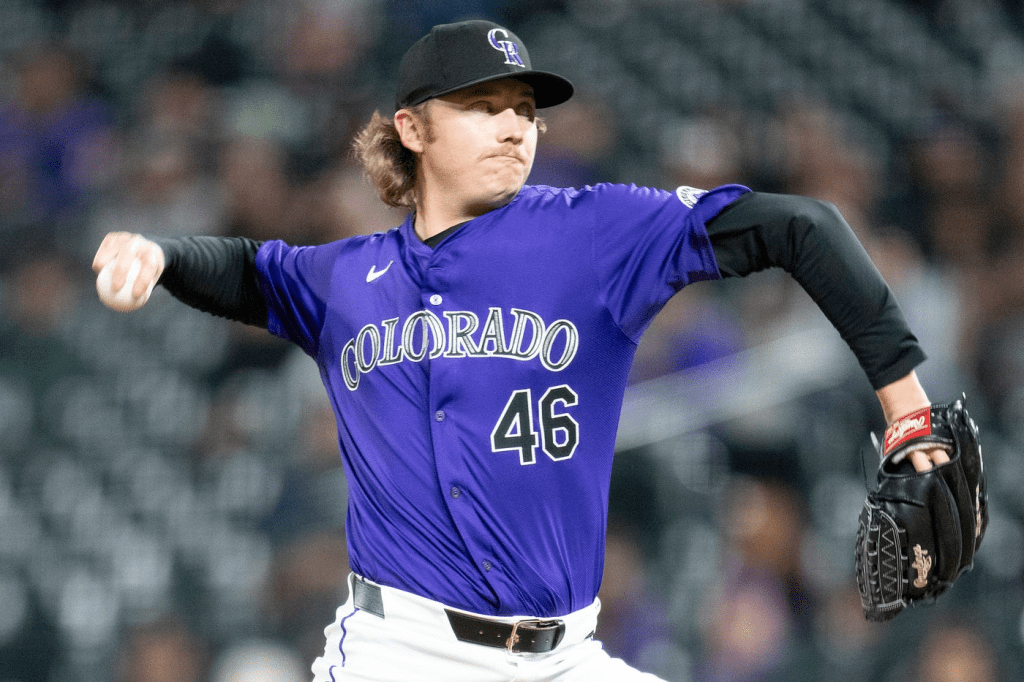
Mears’ HAA (horizontal attack angle) has increased while his VAA (vertical attack angle) has decreased; while normally not an ideal change for a fastball with ride, Mears also has well-below average horizontal movement; think Pete Fairbanks. Likely, his fastball has cutting action to a hitter’s eye, which is exaggerated by that HAA. Mears doesn’t have the release height of a Fairbanks and his velocity is a half a tick down, but he does have more quality off-speed offerings that also would be better outside of Coors.
Mears’ two distinct breaking balls — a hard gyro slider and a big 12-6 curveball — were completely different the last time he called a stadium under 5,000 feet his home. He used to run out a below-average sweeping slider and a curveball similar to his current, but that spun over 200rpm less. Because the slider relies on gyro drop, it likely wouldn’t receive a massive boost in effectiveness from leaving Coors. However, his new curveball breaks downward at about -13.7in of IVB, good for around the edge of top 50 in baseball. If we take Nathan’s quote as gospel and say that Mears’ pitches are moving at around 82% of what they would be at sea level, then the adjusted break average would be around -16.7in — which is now hovering at the edge of top 10, not top 50.
Mears would benefit greatly from a move to a coastal team like his hometown Giants. His 4SFB would play much more and his vertical movement would go from good to upper echelon elite. His breaking pitches would also improve, particularly his curveball, and he would have one of the most devilish IVB splits in baseball. So, as the title of the article says, Nick Mears just really needs to go home.

Justin Lawrence
RHP, Colorado Rockies
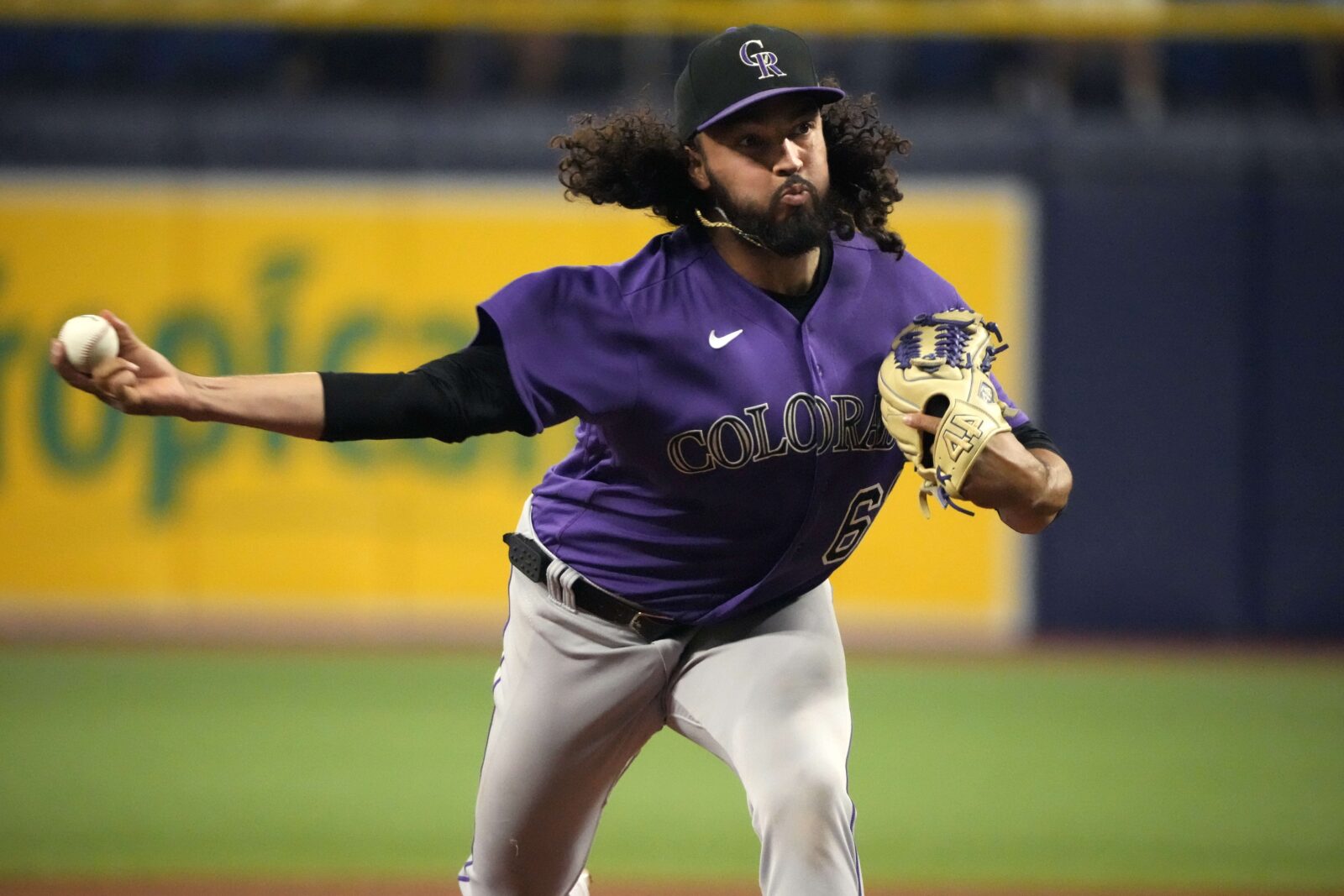
When Justin Lawrence made his MLB debut in 2021, he made waves, and for good reason. He approached a submarine release point, but the ball exploded out of his hand at an average of 97.4 MPH. He complimented it with a sweeping slider that broke the other way hard. How would this guy ever be touched in the big leagues?
Hitters figured it out pretty quick, and Lawrence has stumbled to a career 4.98 ERA to this point; however, there is likely a lot of bad luck involved. Coors effect etc., but Lawrence’s xERA typically has sat much lower than his actual ERA.
The horizontal break numbers are going to be out first big point here. Lawrence’s sinker breaks -15 inches, while his slider breaks 15 inches. Two opposite directions, same amount of break, for a split of 30 inches between the two. As a reminder, the plate is 17 inches wide. To a hitter, before they can recognize spin and break, a pitch starting down the middle could end up in either batter’s box by the time it gets to the plate.
Lawrence could benefit from leaving Coors just like any other pitcher could, but particularly because of his pitch mix. Leaving Coors would likely add 2-3 inches of break to both of his pitches, causing the split to go from 30 inches to a likely 34-36 inches, a massive 15%-20% difference that would make it that much more difficult to hit him.

Another reason Coors is effecting Lawrence in a negative way is because of the way his breaking pitch spins. Lawrence throws a high-spin sweeping slider, one of the highest RPM sweepers in the league. The magnus effect is most highly effective on higher-spin pitches, which is one of the reasons so many pitchers chase RPMs. It is possible a move away from Coors could boost Lawrence’s sweeper movement even more than one would expect.
Barring a trade, Lawrence is under Rockies team control until 2029, so he likely won’t get a chance to see what he could do in another home stadium anytime soon. However, when he does get that chance, it will be interesting to see if his stuff plays differently.
Emmanuel Ramirez
RHP, Miami Marlins
You may be confused. Isn’t this about guys that Coors effects? Why is there a Marlins rookie with 4 IP in his career on here? Wouldn’t it only be Rockies?
Here’s my rationale: Coors can go both ways, and the Rockies have such a unique environment that I’m always fascinated by how they build their team. The air density of Miami and the air density of Colorado couldn’t be more different, and I think that Emmanuel Rodriguez would be a player that would do perfectly fine in Coors, and that the Rockies should probably make a priority target.
I opened this piece by talking about Rosen’s article on Matt Waldron and the knuckleball. Ramirez is not a knuckleball pitcher, but you may not be aware that he’s the closest thing to it.
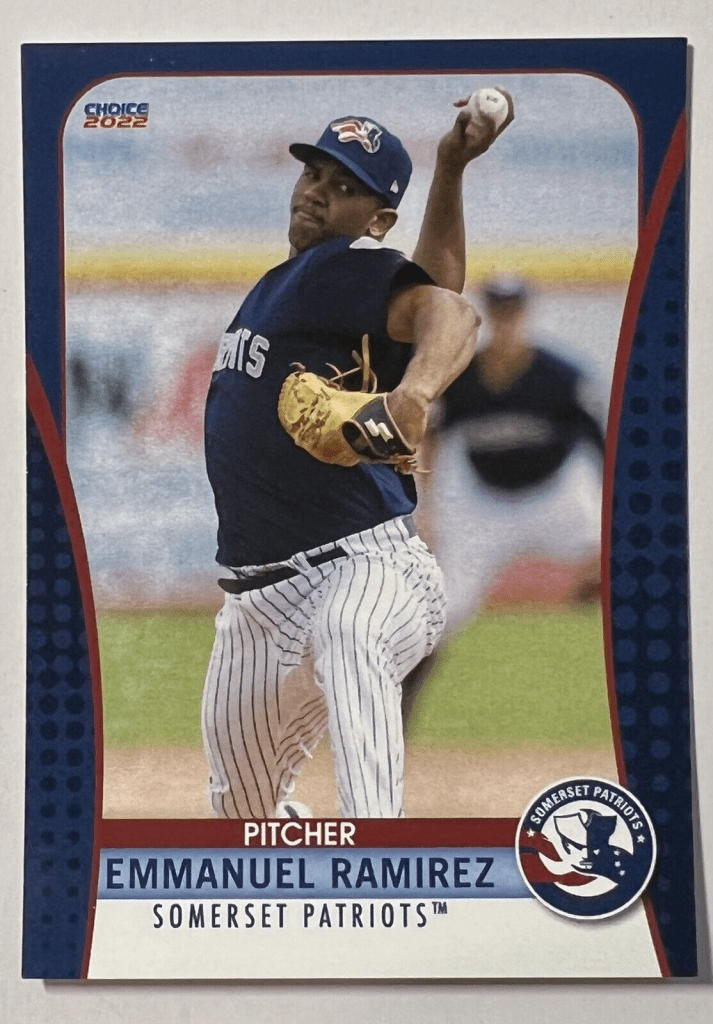
Ramirez primarily throws two pitches, a fastball and a splitter, and he’ll occasionally mix in a slider. The fastball isn’t bad; it’s a ride-based fastball with 18.8in IVB on average. The slider also isn’t bad, but he throws it sparingly. But the splitter is what I’m most interested in.
You can see from the old minor league card to the left his grip; he holds it very wide and because of this kills a lot of spin. Just how much is extremely impressive.
Ramirez’s splitter averages 470rpm, only about 200 more than Waldron’s knuckleball. Because of this, it tends to be a little wild, as well as have dancing, tumbling action as opposed to any particular break. I wonder if the same things that Rosen mentions as possible positives for a knuckleballer in Coors may take effect on Ramirez’s split.
Of course, a move to Coors would mean that the fastball plays less, which can possibly cause issues as well. However, I think when you’re the Rockies and you’re still looking for just about anything to offset the disadvantage your pitching has, you throw things at the wall and see what sticks. Ramirez would be a cheap, controllable option if they were able to get their hands on him.
Plus, what a fun pickup for Rockies fans, because that splitter is ridiculous.
Conclusions
Clearly, the biggest issue at play here is Coors Field, as it often is with things relating to environmental factors; however, there are more applications that can be interesting to explore here. How might a free agent pitcher’s arsenal react to a change in environment? What areas might compliment the movement profiles of one player versus another? Do different factors effect different planes of movement differently? All interesting questions that need answering, especially as players, coaches, front offices, and fans continue to try to do the impossible and figure out this game.
Josh Bookbinder is a writer for and co-founder of LowThreeQuarter. See more of his work and others’ work on the site through the links at the top of the page, or explore another recent article linked below.

What Is Wrong With Jonathan Loáisiga?
Jonathan Loáisiga once showed great promise but has struggled with command and performance since returning from injury. Analyzing his mechanics could reveal paths for improvement and shed light on how players look to improve.


Mike Marshall And The Oddest Cy Young Ever
The article highlights Mike Marshall’s remarkable 1974 season, where he set a record by pitching in 106 games without starting, winning the Cy Young, challenging current relief pitchers’ valuation.

Dream Weaver: The Birth Of A Star (Finally)
By Josh Bookbinder Luke Weaver was supposed to be here, but he also wasn’t supposed to be here. It doesn’t make sense, but it’s right. He’s Supposed To Be Here A decade ago, Weaver was a first-round pick of the Cardinals coming off of incredibly impressive sophomore and junior seasons for the Florida State Seminoles.…

 Low Three Quarter Media
Leave a comment