

By Josh Bookbinder
Gerrit Cole’s heater. Blake Snell’s curve. Corbin Burnes’ cutter. Jhoan Duran’s split. There are plenty of pitches that wow us in baseball, that inspire our imaginations and make us wonder how anyone can hit at the big-league level. From Kershaw’s Cooperstown curve to the prime Aroldis Chapman fastball, there’s often no doubt why some of these arms are generational and special. There are pitches that, to pitching nerds, are the best of the best.
These are not those pitches.
Statcast uses a variety of metrics to determine player value, but when looking at individual pitches, Run Value (RV) is king. TheDrummeyAngle has a great breakdown of how it is calculated, but it essentially boils down to this: a pitchers’ pitch earns a number somewhere between -26 (the worst recorded since 2019) and 36 (the best recorded since 2019) based on the results against it. Note those final few words: it is a results-based stat, not a projection or predictive, and thus is prone to some variability year to year. It is also a counting stat, so the more a pitch is thrown, the more opportunity is has to earn (or lose) value.
This idea came to me when I was checking out this Savant leaderboard. I was wondering what the most-thrown pitch was in 2023 (Spencer Strider’s 4-seamer), and ended up thinking beyond that. I saw a wide spread of dark and light blues and reds, and got to thinking… who was just really bad this year? We all put plenty of attention on the greats, be it player or performance. But what about those who went the other way?
I’m not going to just jump straight to the worst-graded pitch in 2023, for reasons I’ll explain a little later. But here’s a list of some of the worst pitches this past year, a little explanation of why each one stunk, a little discussion of why the stinkiness of that pitch interested me, and what might be done to get better next year.
Martin Perez, Cutter (-13 RV)
What makes Perez’s cutter so interesting wasn’t that it was bad (although it was). It’s the turnaround. In 2022, Perez’s cutter was worth 13 RV, good for third-best out of all the qualifying cutters in baseball. In 2023, it was worth -13. What gives?
Hitters in ’22 had a BA/SLG of .228/.290 on the pitch, and in ’23 a .342/.640. That’s a massive difference, and pretty much accounts for the result change. Batters swing and missed at it way less, from a 17% Whiff% in ’22 to 11% in ’23. And to top it all off, the PutAway% on the pitch went from an elite 27% all the way down to an uninspiring 14%. To sum that up, hitters went from struggling to hit or drive the pitch, and striking out on it a LOT, to absolutely mashing it.
Looking at the pitch itself, there’s not a ton to go off of. The velocity dropped, but not much, averaging 89.9 in ’22 and 89.2 in ’23. He threw it 24% in ’22 and 22% in ’23. The pitch’s vertical movement was nearly unchanged, and the pitch’s horizontal movement actually increased, from 1.1 inches to 2.5. So essentially, the pitch was a hair slower and moved a touch more this year than last. But that’s really not enough to expect it to go from almost the best cutter in the big leagues to almost the worst.
So where does that leave us? Real estate is one avenue we can take: location, location, location. 2022 is on the left and 2023 is on the right down below.
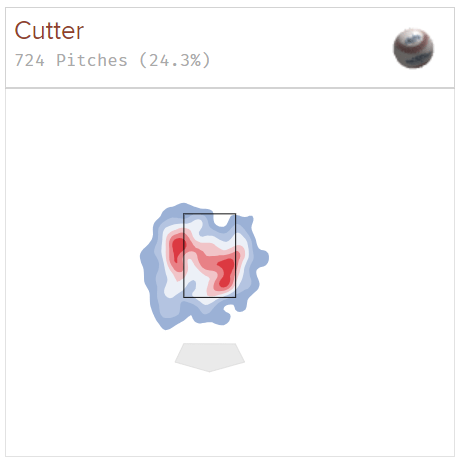

The misses were further off the plate and the consistency of the locations got worse from ’22 to ’23. This could’ve contributed to the turnaround, but it probably wasn’t all of it; those heat maps still look pretty similar.
If I had to venture a guess, I think that scouting just came into play big-time here. Perez hadn’t settled into who he was as a pitcher despite a more advanced age, but a monster 2022 put him on the map and gave him a game plan that worked: mix different kinds of fastballs and locate. Then, teams figured him out: they sat on certain fastballs in certain counts, and Perez’s location faltered some, combining to create a disastrous 2023. Martin went from 99th percentile in all of his fastball values combined in 2022 to 39th in 2023. That’s not going to play, and the cutter took the worst hit out of them all.
Perez has a history of inconsistency year-to-year. Perhaps next year will be an up year. But we might also have to really confront the concern that Perez might be a one-year wonder: his ERA has been under 4.3 once in his 9-year career.
Chris Flexen, Connor Seabold, Austin Gomber: 4-Seam Fastballs (-21, -19, -19)

Ahhh. Beautiful. Can’t you just smell the pristine mountain air? Doesn’t that field look gorgeous?
If only there was a major-league team there.
I joke, of course, and I respect the Rockies players, especially pitchers, a lot. They’re dealt a tough hand, and some of them do fine there. Ubaldo Jimenez, Kyle Freeland, German Marquez come to mind, as well as Daniel Bard and Brian Fuentes in the bullpen. However, many of them are victims to an environment that hates them and an organization that simply can’t play to the strengths that they are given.
Jimenez and Freeland both throw multiple fastballs and rely on sink and horizontal movement. Marquez’s success has come despite horrible fastball performance, and mainly on the strength of incredible off-speed stuff. Bard throws absolute fuel at the back end of the bullpen; an average fastball velocity of upwards of 97-98 can help mask poor movement numbers. Fuentes pitched in a different time, but his fastball also *appeared* to rely on horizontal movement more than anything else.
It’s been proven that in high elevations, ground ball pitchers are king. This makes logical sense: don’t want the ball to fly far, don’t let it fly at all; make it bounce. However, this seems to still mystify the Rockies organization, and they continue to try to get pitchers that don’t fit this mold. It’s also been proven that the ball spins and moves differently at Rocky Mountain type elevations. Pitchers who have done well consistently are pitchers who rely heavily on different types of fastballs that primarily move horizontally or sink, throw effective change-ups or splitters, and/or throw incredibly elite and efficient breaking balls. Low spin pitches down in the zone are the way to go in the mountain west, and the Rockies analytics team just seems to be blind to that fact.
All three of these pitchers throw low-spin fastballs, but ones that don’t move particularly well horizontally. They also throw their fastballs a lot, and throw them up in the zone. No wonder they get tattooed to the tune of three of the worst five 4-seam fastball RVs in baseball.
However, I’m putting this on the Rockies FO, not the pitchers themselves. The pitchers’ profiles may not be perfect for Coors, but they have attributes that could get them to the point that they are effective. Better location in the zone would be a start. However, management has maximizers and minimizers, and it’s clear at this point that the Rockies cannot get the right guys and put them in a position to succeed.
And it’s a shame, too. Denver is great, and just look at that beautiful ballpark.
Phil Bickford, Slider (-14)
The worst off-speed pitch in baseball last year belongs to one of the most fascinating pitchers in baseball. From a junior college in Nevada comes a wildly long-haired, often mustachioed, 6’4″ 200-pound righty with a skill set that just makes no sense.
I know we’re talking about bad pitches here, but to understand Bickford’s bad you must first understand his good. Phil throws his 4-seam fastball 71% of the time, good for 4th highest percentage anyone throws a single pitch in MLB. And it is outstanding, posting a 12 RV on the year in 2023. It was also outstanding in 2022, posting an 11 RV.
How, then, did Bickford sputter to a 4.72 and 4.95 ERA in ’22 and ’23? With a 90th percentile value fastball, how bad is the rest of his stuff that he is consistently 10-14 points below average in ERA+?

…oh.
As good as his fastball has been, his other pitches have been horrific. And even using a plural there is generous, considering he threw his slider 27% of the time and his changeup 2% (only 25 total pitches). Bickford is essentially a 2-pitch pitcher with one of the best fastballs in the league and one of the worst sliders. He’s a little like a video game experiment in that regard, a created player just dropped into the league to see what happens.
The pitch itself isn’t awful. It’s something even worse: it’s average.
When comparing movement profiles on pitches, Baseball Savant gives both the raw numbers and movement “vs. Avg”, which compares pitches to others similar. In this sense, you’ll often see numbers that are more extreme do better. Obviously it’s good when a pitch moves more, but it’s also often good when a pitch moves less. Anything that doesn’t move like other pitches that batters regularly see can be very effective.
Bickford’s slider might as well be the stock slider that comes in your “relief pitcher starter pack”. It’s 83 mph, drops 37.4 inches, and moves horizontally 6.5 inches. Horizontally, it moves 0.3% more than the average, and vertically, it moves 0.1% less than the average. It’s absolutely nothing special, which is the reason it gets hit so hard. It got touched up to the tune of a .290/.541 BA/SLG, which certainly qualifies as getting “hit hard”.
Bickford is the kind of pitcher that orgs can dream about. He has an elite tool and knows how to use it. The slider just doesn’t play, but keep an eye out for him to be a guy who finds something and just clicks. A good off-speed pitch can only make his already-great fastball better, and he’s 28; pitchers have clicked later in their careers than that. Keep an eye on Bickford to make a turnaround should he find something that can help him compliment his heater.
Adam Wainwright, Sinker (-23)
Joey Wentz was quaking in his Detroit-sized boots reading this. The Tiger pitcher clicked on the link to the leaderboard and saw his name at the top. 4-seam fastball, -23 RV. You can breathe, Joey. This is your only mention, even though you earned the heck out of the -23 RV that got hit at a .374/.682 BA/SLG. (For reference, Ty Cobb hit .366 on his career, and Barry Bonds had a .683 SLG from 1997-2007. Joey Wentz’s fastball was like taking your chances facing a combination of those two every time he threw it.)
No, here we’re talking about the Cardinal darling, the man who had possibly the worst retirement tour ever. Adam Wainwright had the worst pitch in baseball this year in his sinker.
Why disregard Wentz, despite the tie at -23 RV? RV is a counting stat, as mentioned. The more a pitch is thrown, the more opportunity it has to earn value. Wentz threw his four-seamer 803 times, good for 70th-most out of the 600 4-seamers used over 25 times. Wainwright only used his sinker 560 times, but managed to accrue the same amount of “value”.
Waino’s sinker has been valuable in the past. As recently as 2021, his sinker was worth 16 RV, and was one of the more valuable in the game. However, time caught up to the 42-year-old this year. It was most noticeable in fastball velocity; while the number has steadily dropped for years, the 85.7 that he was slinging this year wouldn’t inspire a lot of college recruiters, let alone Major League Baseball organization.
However, Wainwright did play for a terrible St. Louis team this year, so his performance didn’t hurt them too badly. He got his 200th win, and one would hope, some closure with it. He’s got a long history of success, both in personal and team performance. He’s one of the most beloved players of all time, and is seemingly going to be courted heavily to be a broadcaster. He retired officially because he got a puppy. It’s hard to really crush him for a bad year, and tough to give him the dubious title of “Worst Pitch In Baseball”.
But someone has to do it.
Conclusions
There were more, of course. Baseball, as a zero-sum game, is going to have plenty of pitchers who are below average. Cases could be made for many of the 1,156 pitches that earned a negative run value in 2023. However, these stuck out.
Hopefully, we’ll see these guys and their pitches on the other side of the run value scale sooner rather than later.
Josh Bookbinder is a writer for and co-founder of LowThreeQuarter. See more of his work and others’ work on the site through the links at the top of the page, or explore another recent article linked below.




 Low Three Quarter Media
Leave a comment