

By Coleman Smith
Bryan Woo made his Major League debut on June 3rd in newly opened Globe Life Field after a fantastic start to 2023 in AA Arkansas. The outing would last less than 3 innings, with Woo allowing 7 hits and 6 earned runs in just 2+ innings of work. He would make a solid start a week later against the Angels, before rattling off five straight outings in which he completed at least 5 or more innings with 2 or fewer runs. Woo would remain in the rotation through the rest of the season for the M’s, save for a 15 day stint on the IL in August for right elbow inflammation.
Woo’s 2023 Major League stint was solid for a rookie, posting a 4.21 ERA in 87.2 IP while striking out 93 hitters to just 31 walks. His SO/W numbers were similar in the minors with a decent dip in K% after he jumped to the majors, suggesting he could possibly have room to improve next season in that area. Another area he could look to improve on in 2024 is his home run rate, allowing 13 homers across his innings in the majors, good for a 1.3 HR/9. Woo’s 13.4% HR/FB% also suggests this number could have room to fall next season if it moves closer to the league average of 12.7%. If we take a look at the pitches hit for a homer off Woo last year, we also see something of note.

Two of these pitches are pretty far off the plate, so let’s dig a little deeper. First is the fastball at the top of the zone. Woo’s fastball plays extremely well up in the zone, which we’ll expand on later, but what we need to focus on in just how high this pitch is. Baseball Savant allows us to view the pitch in question by clicking on it, but i’ve attached the video below for easier viewing.
This pitch is WAY up there, and Sabol beats it to the spot and manhandles it 407 ft out to dead center. Sometimes you have to tip your cap and say “that’s baseball”, but that’s a well executed pitch nonetheless. Now let’s take a peek at the slider off the plate.
Another well executed pitch, this time a back foot slider, but this time the $700 million dollar man yanks it out to right for a homer. Oh well, at least that guy’s in the other league from now on. The point here is that these are both pitcher’s pitches where the hitter made an outstanding play to get the ball over the fence. If Woo executes pitches like this over the course of the season, way more often than not things are going to go his way.
Before we talk about Woo’s arsenal, we need to talk about his release. His release height of 4.9 ft is one of the lowest in the entire league, creating different angles for his pitches to attack than hitters are used to seeing. He combines this with 6.8 ft of extension, in the 84th percentile, allowing hitters less time to see his pitches and making them seem faster than they are. He uses this unique release to throw hitters off despite less than stellar velocity or shape on his pitches, relying on deception as well as his stuff.
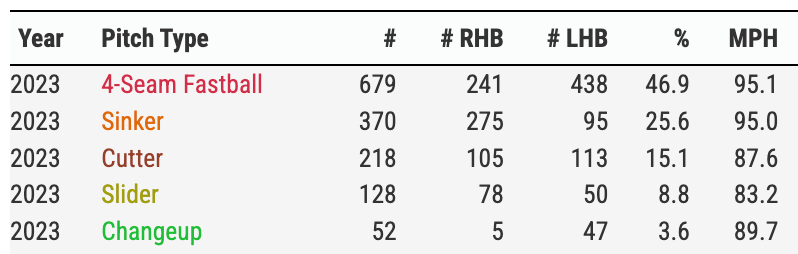
Woo’s go to pitch is his 4-seam fastball, and for good reason. The pitch had a well above average 16.2% swinging strike rate last season, as well as .282 xwOBA. These numbers come despite average horizontal break and below average induced vertical break (IVB) numbers, as well as about league average velocity. To figure out why, we need a quick rundown on Vertical Approach Angle (VAA). In short, VAA is the vertical angle in which a pitch is approaching home plate. A pitch can be “flat” with a VAA closer to 0, or can be “steep” with a higher VAA. The VAA affects different pitch types differently, and to quote the Fangraphs primer, “The flatter a pitcher’s four-seam fastball, (1) the lower in the zone it can induce whiffs (per swing), and (2) the larger its margin for error throughout the zone”. Woo’s release point and extension create a +0.94 degree VAA above average on his fastball, good for a 70 grade on the 20-80 scale. His -3.8 degree fastball VAA was tied with Joe Ryan for the lowest among all starters last season.
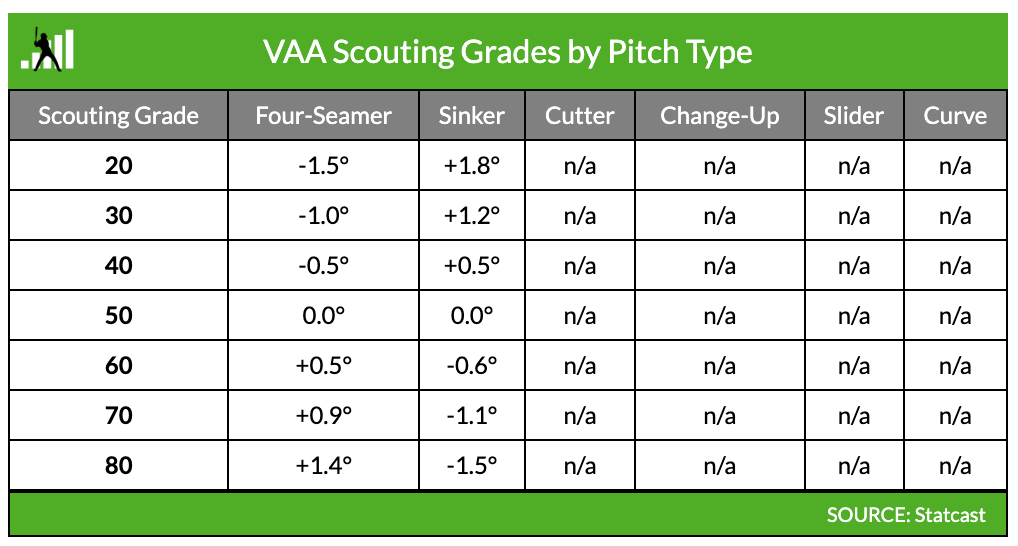
Woo’s extremely flat VAA also allows a greater margin for error with his fastball up in the zone, where he can take full advantage of his elite extension and low release point to induce more swings and more whiffs. His SwStr% rivals that of truly elite fastballs like Jacob DeGrom’s, despite averaging over 3 mph slower.
Woo plays off his 4 seam with another fastball, this one a sinker. His sinker utilizes the effects of seam shifted wake (SSW) to create a unique movement profile despite very similar initial spin based movement to his 4 seam. Comparing the images below, we can see how the spin based movement differs for the sinker from the observed movement. Woo uses this effect to create a well above average 16.5 inches of arm side run, despite a below average 6.6 inches of IVB.
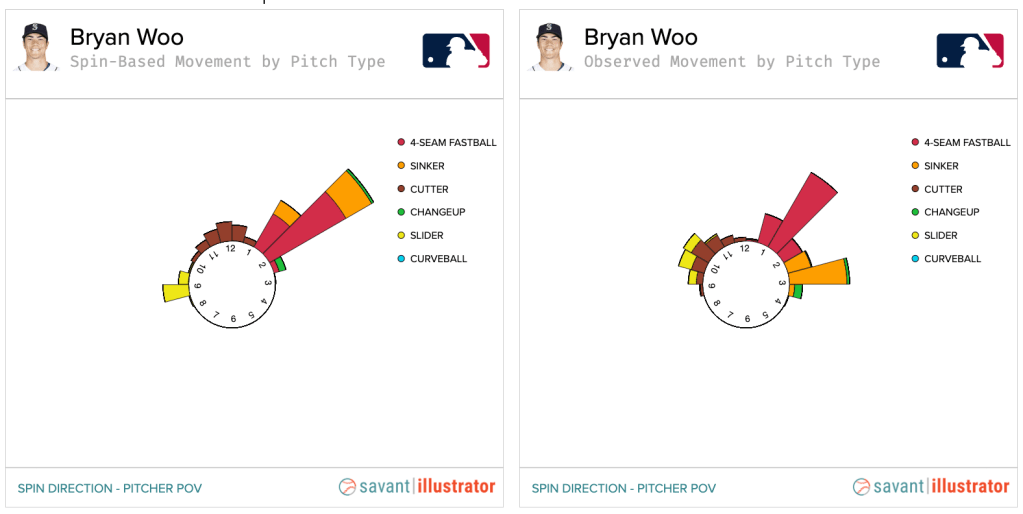
Usually, a SSW sinker is thrown by supination bias pitchers without an ability to throw a rising fastball. The flat, rising fastball’s are typically reserved for pronators like the aforementioned DeGrom, who pair a high velocity, high carry fastball with a gyro slider and changeup. Woo is able to combine his low release point and extension with his supination to create a combo of fastballs that utilize both low VAA and SSW characteristics to throw pitches normally not seen together in a pitchers arsenal. His supination will come into play later on, but for now let’s take a look at his cutter/slider.
Woo’s Cutter is his third most thrown pitch, being used 15.1% of the time. The pitch functions as more of a gyro slider than a typical fastball cutter, coming in at 4.1″ IVB and 4.0″ horizontal break. The pitch is a solid swinging strike pitch and had an elite 2.9% barrel rate. The pitch works well to keep hitters off balance, but was far from his best or most interesting pitch last season. Interestingly, the pitch’s usage does not vary much based on hitter handedness, which we’ll touch more on later.
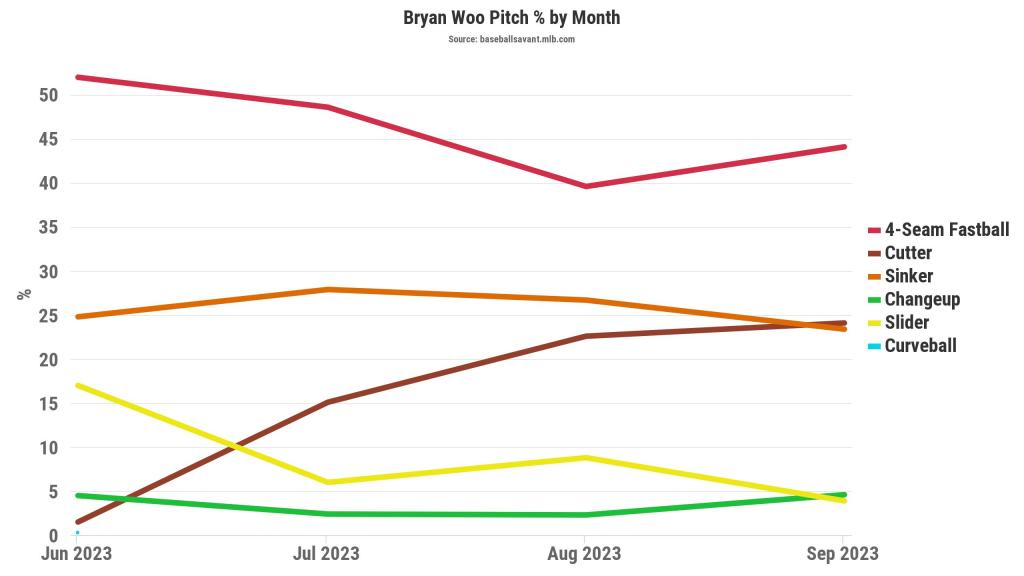
The 4th pitch in Woo’s arsenal is called a slider on savant, but has the characteristics of a sweeper. The pitch possessed a slightly below average 14.4% SwStr%, but combined it with a .238 xwOBA and just 3.8% barrel rate. The pitch has an extremely unique movement profile, with 13.6″ of horizontal movement that placed in the top 15 sliders thrown at least 25 times by SP. This sweeping action normally leads to a higher Whiff% and inflated barrel rate, yet his slider has a lower barrel rate than DeGrom and Dylan Cease, who throw very good gyro bullet sliders. Woo only threw this pitch 8.8% of the time in 2023, and as you can see below the usage dropped off over the course of the season in favor of the cutter.
Woo’s 5th and final pitch is an inconsistent changeup that doesn’t have many special characteristics. The pitch had just a 4.2% SwStr% and was thrown just 52 times, 65.4% of the time being thrown out of the zone. The pitch was only chased 11.8% of the time, meaning many times it simply resulted in another ball. The pitch was thrown almost exclusively to left handed hitters, but even when it was thrown in the zone to them they hit it extremely hard, with a 98.5 mph average exit velocity in 7 BBE.
The struggle with left handed hitters wasn’t only limited to his changeup. Each one of his pitches had a worse wOBA against lefties than righties, and overall the splits are scary. Against right handed hitters, he allowed a slash line of just .179/.226/.268, good for a .495 OPS with 4 home runs and 45 K’s to 9 walks. But against left handed hitters, he fared far worse giving up a .283/.389/.540 .928 OPS with 9 homers and just 35 K’s to a whopping 23 walks. Woo’s 25.3% whiff% against lefties is far worse than the 30.9% rate he posts against righties. His strike % drops 5% against left handed hitters, showing he may be trying to be a little too perfect against them. Woo lacks a 2 strike put-away pitch against left handed hitters that can keep them off balance of the fastball, causing the 4 seam to play much worse against them, with a 40.4% whiff rate against RHB but just 25.2% against LHB. Woo’s current arsenal is not very well suited to get outs against hitters on both sides of the plate, and he likely needs to add or change shapes of a pitch to achieve better results.
One pitch Woo could possibly look to add to help overcome his splits is (no pun intended) a splitter. The table below compares splitters and changeups thrown by RHP vs LHB in the 2023 season.
| Pitch | AVG | OBP | SLG | OPS | Launch Angle | SwStr% |
| Splitter | .204 | .249 | .314 | .563 | 4.4 | 16.6% |
| Changeup | .241 | .286 | .376 | .662 | 7.3 | 14.1% |
Right on left splitters are swung and missed at more, have a lower launch angle, and worse OPS than changeups. Woo’s changeup is already his worst and most inconsistent pitch. He struggles against left handed hitters, where splitters perform better than changeups. In Adam Salorio’s article on why the splitter is poised for a comeback, he outlined why Woo’s movement profile is perfect for adding a splitter as well, allowing it to play off the sinker as shown below.
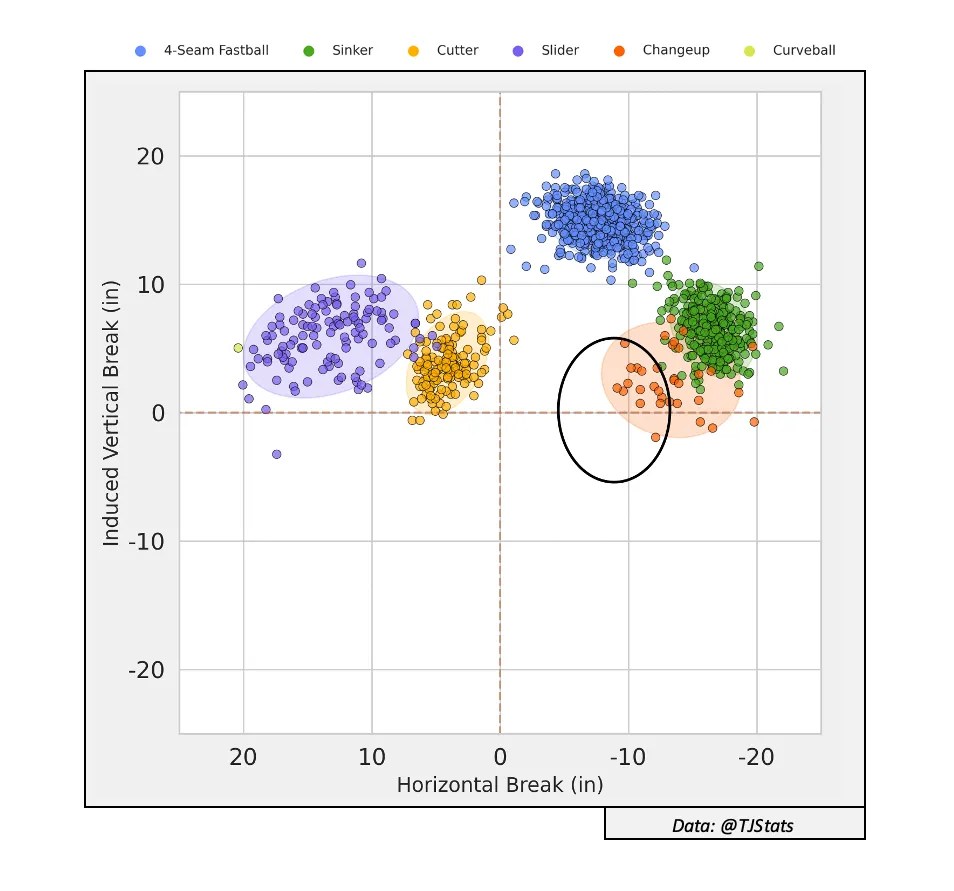
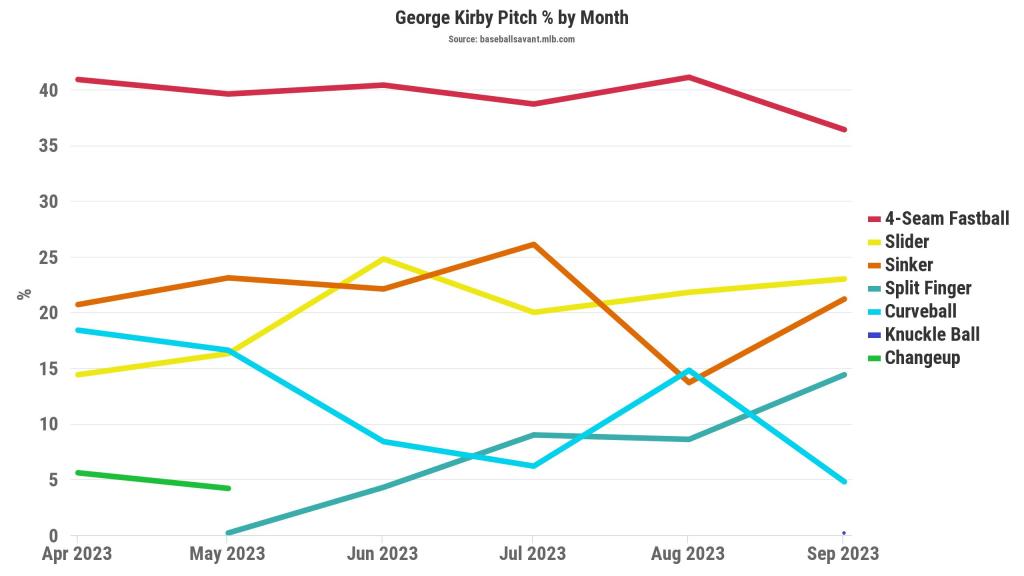
The splitter is a notoriously tough pitch to learn and throw consistently, but it has been done with success by pitchers similar to Woo. This season, the Twins Joe Ryan scrapped his changeup in favor of a splitter with great results. You may remember Ryan from our earlier discussion on VAA; he’s another low release point, flat fastball thrower who relies on high fastballs for swings and misses. Woo’s teammate George Kirby also added a splitter to his arsenal this season, growing more comfortable with the pitch and increasing its usage throughout the season.
Woo’s struggles with his changeup may be due in part to supination bias, as the changeup relies on pronation to create side spin to give the pitch horizontal break to a pitchers arm side. If we look at Woo’s movement profile compared to Devin Williams, whose changeup may be the best in the game, we see some stark differences in the pitch.
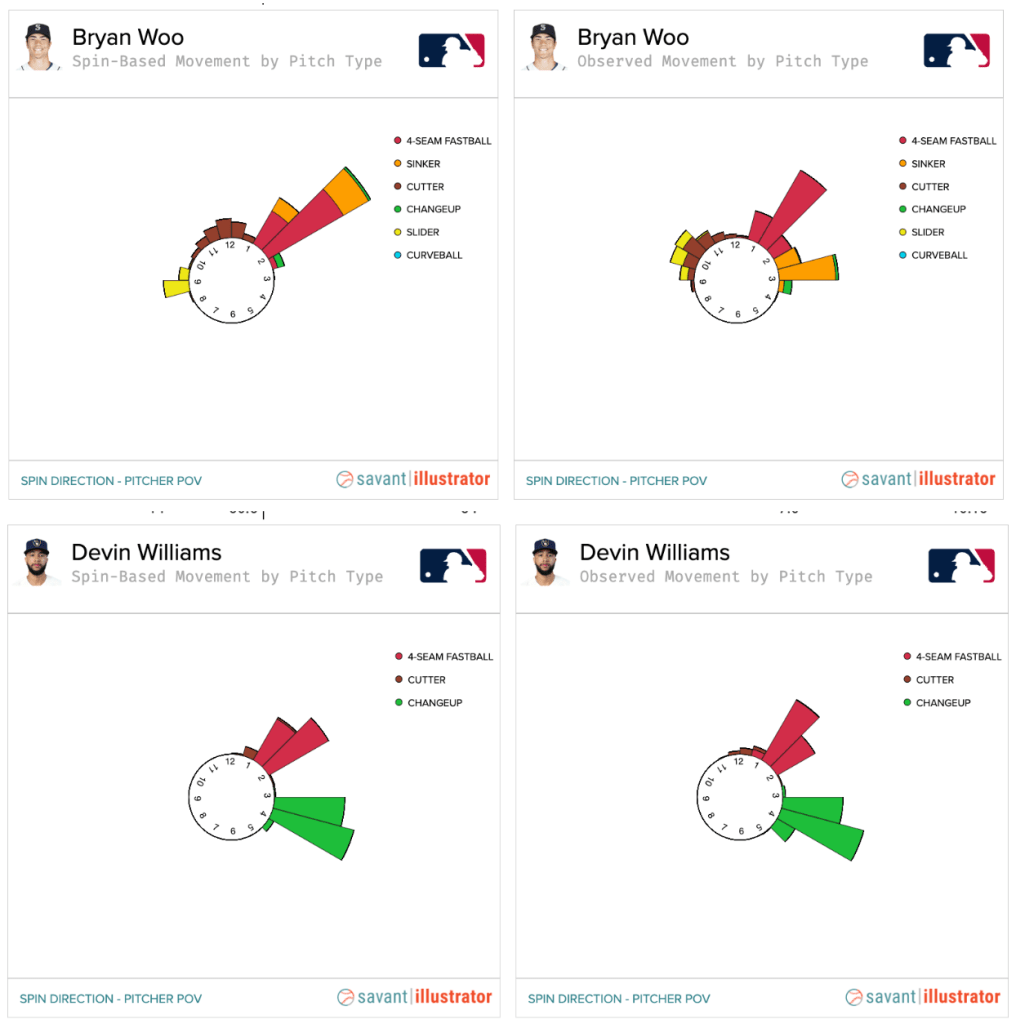
Williams spin-based and observed movement profiles are very similar, around 3:15-3:30. Woo’s changeup has a dramatic difference in spin and is much higher on the “clock” at 1:45 spin-based and 2:45 observed movement. This difference may cause the pitches inconsistency and lead to less horizontal break. By scrapping or converting the pitch to a splitter, Woo may be able to take better advantage of his supination release to create vertical break and keep hitters off balance. The splitter may be difficult, but it also may be the key to unlocking Woo’s full potential against all types of hitters and allow him to go deeper into games, and he’s got help in-house to share some wisdom.
Fangraphs Roster Resource currently has Woo slotted into the Mariners 5th starter spot for the 2024 season. Steamer is projecting Woo for 21 games started, with 132 IP and a 3.97 ERA with a 24.9% K% and 7.8% BB%. The K% is in line with his 2023 number, but the BB% is actually a decrease. They also project Woo for 1.3 HR/9, which is right around his 2023 number in the big leagues but as mentioned earlier, that number may have room to come down. If his home run rate can come down a tad, Woo could perform far better than projected next season.
If Seattle follows their rotation schedule the first few times through the order and doesn’t skip guys due to off days, Woo’s first four starts will come as follows: vs CLE, @ MIL, vs CHC, at COL. The Guardians are the only left handed heavy lineup out of the four, but they and the Brewers should be two of the softer lineups in the league in 2024. While the Cubs scored the 6th most runs in 2023, their lineup is RHB heavy and they will be without Cody Bellinger and Jeimer Candelario who departed in free agency. Pitching in Colorado is always a tough task, but their lineup features just 3 left handed hitters, one of them a soon to be 38 year old Charlie Blackmon. Woo’s first month of the season sets up pretty well for him to have a fast start to the 2024 season, and if he starts hot and sticks in the rotation good things could be in store.
 Low Three Quarter Media
Leave a comment