

By Coleman Smith
In doing research for this article, one thing quickly jumped out to me: Louie Varland may be the most Twin Cities player to ever wear a Twins uniform. Varland was born in St. Paul, Minnesota, played college ball at Division II Concordia University St. Paul, and has not been part of any professional organization besides the Twins. He was selected as a 15th round draft pick in the 2019 MLB draft, after which he would throw 8.2 innings in rookie ball to finish off the 2019 season before the entire 2020 minor league season was wiped away by COVID-19. He would come back and flourish, carving through minor league hitters in 2021 and most of 2022 before being called up for his major league debut on September 7th, 2022 against the New York Yankees. Coming into 2023, Varland figured to compete for a rotation spot, however some bumps along the way foiled his first full season in the bigs.
2023 – What Happened?
| 2023 | GS | IP | ERA | K% | BB% |
| Louie Varland | 10 | 68 | 4.63 | 25.1 | 6.0 |
Coming into 2023, it appeared Varland would compete for a back end rotation spot early in the season. That came to fruition in April when Varland was called up to start in place of the injured Kenta Maeda. He would be optioned back to the minors just two days after this start however, before being called up again in May.
This second stint was a little more permanent, with Varland remaining in the Twins rotation through mid-June. He was solid in six May starts, pitching to a 3.34 ERA in 35 IP, before things would go south in June. After three consecutive starts in which Varland was tagged for at least four runs, he would once again be optioned to AAA. He would continue starting in AAA until the end of August, when the Twins decided to shift him into a bullpen role before he was once again recalled on September 4th.
In seven September appearances Varland pitched to a 1.50 ERA with 12 IP, going multiple innings in four of seven outings. His velocity was up across the board during this stint, which makes sense given the shorter outings, but he also posted a 40.4% K% and 2.4% BB% out of the pen. The velocity was especially noticeable, with Varland suddenly flirting with triple digits and running a couple of fastballs like this one to Daniel Vogelbach over the century mark.
Varland’s arsenal went through some significant transformation in 2023, with noticeable changes taking place between each of his stints in the big leagues. We can get a glimpse of this through taking a peek at his pitch velocity’s by month.
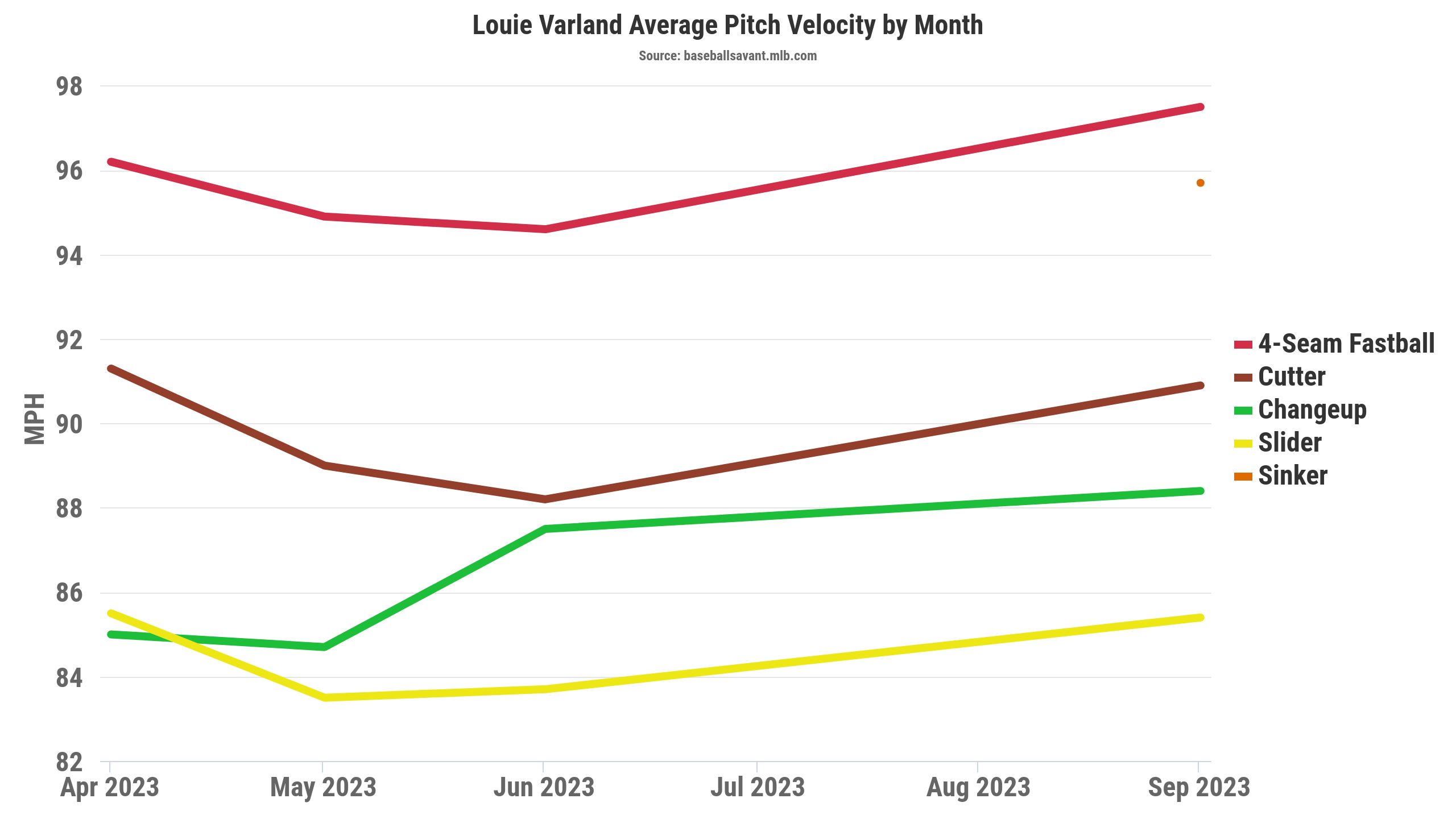
Each one of Varland’s pitches went through some sort of change in 2023, with some looking different in all three stints, as well as adding a new pitch in September. Let’s go pitch by pitch and take a look at what changes the Twins were making under the hood.
For the pitch shapes described below, we use induced vertical break (IVB) and horizontal break (HB). To put it simply, IVB measures how much a pitch breaks without the effect of gravity using a positive and negative scale from 0. A higher IVB indicates more “rise”, while a lower number indicates more depth. Horizontal break is pretty straightforward: how much a pitch moves side to side positive and negative from 0, with positive moving to a RHP glove side and negative to the arm side.
Fastball
| Velocity | IVB | HB | |
| April | 96.2 | 15.8 | -5 |
| May/June | 94.8 | 16.4 | -7.7 |
| September | 97.4 | 16 | -8.7 |
Varland opened the season with above average velocity on his fastball in his first start, before it would drop off to 94.8 mph over his nine start second stint. Over this stint, his fastball shape and velocity almost perfectly mirrored league average for a RHP: 94.5 mph 15.8 IVB -7.3 HB. Being close to league average for a pitch is bad, it’s important for pitches to have outlier characteristics. When Varland came back for his third stint, his velocity was ticked up even higher than his April start, likely due to shorter outings, but he’d also added another inch of HB, now over three and a half inches greater than his April fastball shape. Varland’s fastball also benefits from his 90th percentile 6.9 ft extension, releasing the pitch closer to the plate than other pitchers and giving hitters less time to make a swing decision.
Cutter
| Velocity | IVB | HB | |
| April | 91.5 | 7.5 | 4.3 |
| May/June | 88.7 | 5.6 | 4.2 |
| September | 90.9 | 8.1 | 3.2 |
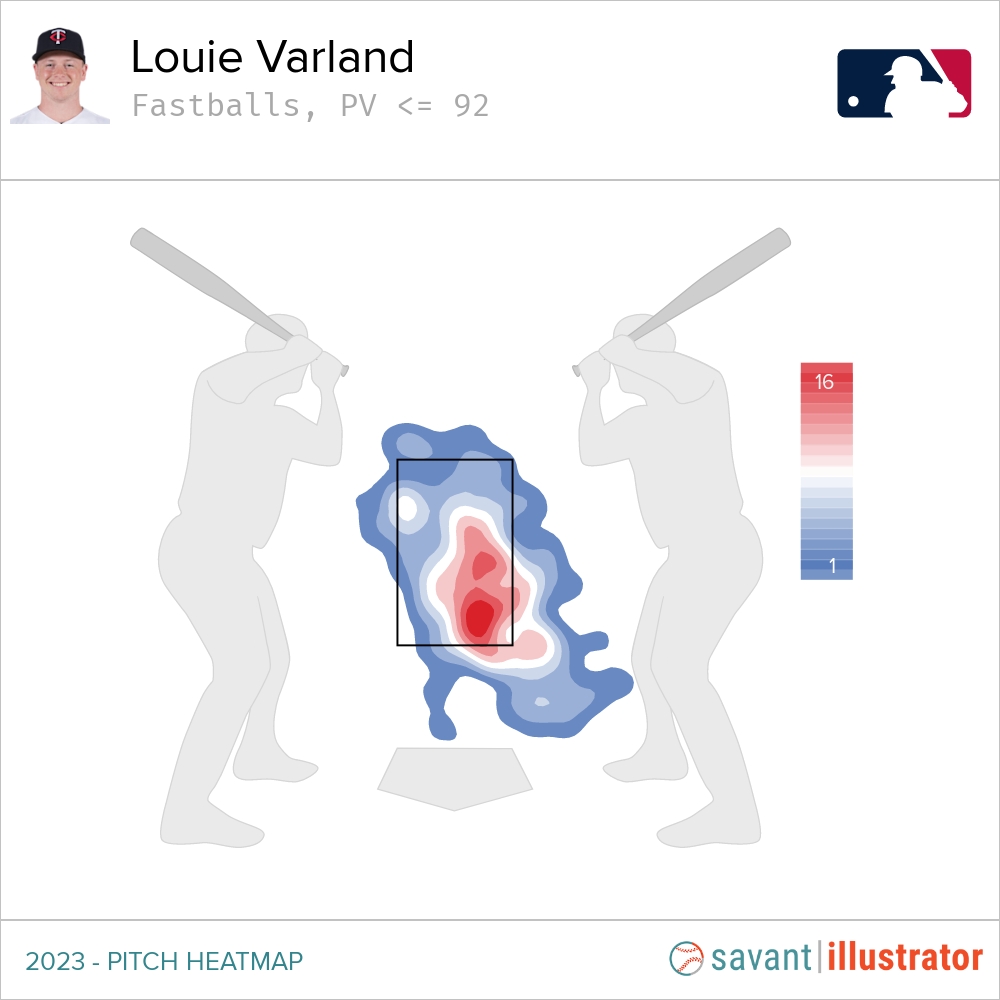
Varland’s cutter was his second most thrown pitch in 2023, and went through three pretty distinct shapes. The April version was the hardest, clocking in at 91.5 mph, and had the most horizontal break at 4.3 inches. When he returned for his second stint he wasn’t throwing the pitch as hard, and as a result it added a couple inches of drop from the previous iteration. The cutter thrown in September was the tightest, adding 2.5 inches of IVB (meaning it dropped less), and losing an inch of horizontal break. The version thrown in September easily performed the best, with a .102 wOBA and 45.7% whiff rate.
If we take a look at Varland’s cutter heat map, we can see a conscious effort to throw this pitch down to his glove side of the plate. He commands this pitch well, and in September it was arguably the most important pitch in his arsenal. Here’s a look at that version of the cutter to get Luis Robert swinging.
Slider
| Velocity | IVB | HB | |
| April | 85.7 | -0.5 | 8.5 |
| May/June | 83.5 | -0.6 | 10.8 |
| September | 85.4 | -1.7 | 5.2 |
The next pitch in Varland’s arsenal went through the most transformation of any last season. Like the cutter, Varland threw three versions of the slider in 2023, with varying amounts of sweep and velocity. The first version had an above average amount of sweep, coming in at 8.5 inches of horizontal break while clocking in at 85.7 mph. In his second stint, he cut almost 2 mph off the pitch while adding over 2.5 inches of horizontal break. At this point, the pitch appeared to be almost turning into a sweeper, a slower, more horizontal breaking pitch that often creates more swing and miss at the expense of more barrels. This version however failed to miss bats at an exceptional rate, so the Twins decided to make a change again. The September iteration would go in the opposite direction, returning to the April velocity and cutting the sweeping action by over five inches. This pitch would also add an inch of vertical depth, lending itself to more of a gyro slider shape. His September sample size wasn’t large enough to draw conclusions on the pitches effectiveness, but the shape is certainly something to keep in mind.
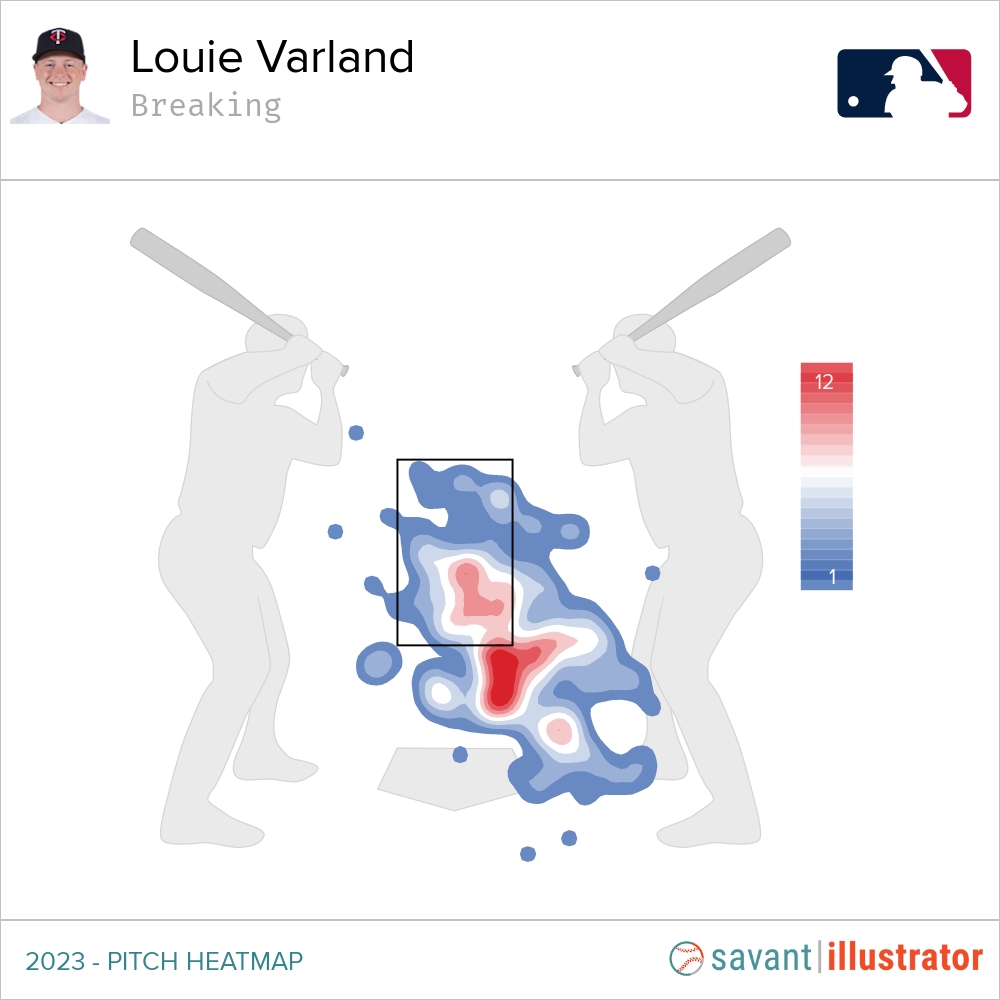
Varland is very effective in playing this pitch off his cutter through location, consistently spotting the slider just below where the cutter is typically thrown in the zone to the down and glove side part of the plate. This pitch developing into a true swing and miss pitch to play off his fastballs may be the key to unlocking Varland’s full potential. Here’s a look at the slider against Jose Ramirez (video below).
Changeup
| Velocity | IVB | HB | |
| April | 85 | 4.5 | -11.9 |
| May/June | 84.7 | 8.4 | -14.4 |
| September | 87.5 | 5 | -14.9 |
Varland’s off-speed pitch is a changeup that also saw some transformation in 2023. From April to May the velocity would stay relatively consistent, but the shape was overhauled. The pitch had almost four inches less of depth, while adding 3.5 inches of horizontal break to his glove side. This version of the pitch appeared to be the most effective, with a 12.2% swinging strike rate and 30% whiff rate. The pitch however would be overhauled again, adding almost 3 mph of velocity while losing the depth gained in May/June but adding a bit of horizontal break.
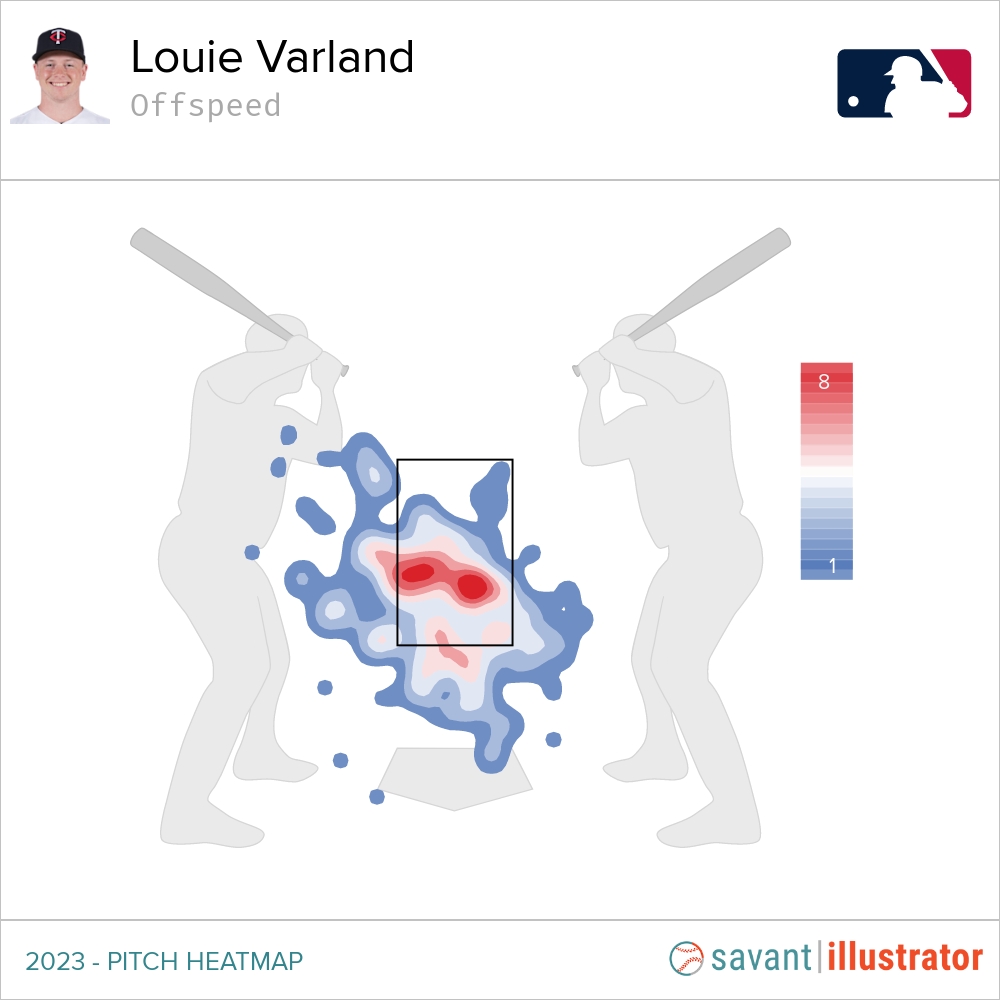
Once again sample sizes for this version of the pitch are tiny so it’s hard to say how effective it was, in the smaller sample it performed much worse than the previous version. This pitch also saw it’s usage rate drop throughout the season, which could be something to monitor as it’s his main offs-speed/breaking ball to left handed hitters. Varland also appears to struggle to command this pitch, unable to consistently spot it at the bottom of the zone.
Sinker
In September, Varland added a fifth pitch to his arsenal, a sinker. This pitch was thrown exclusively to right handed hitters, and it’s evident by his heat map he was trying to keep the pitch down and in. While he already had an above average groundball rate in 2023, a sinker could allow Varland to keep even more balls on the ground in the future if the pitch sticks in the arsenal. This was also interestingly the only pitch Varland seemed to consistently spot to his arm side of the plate.
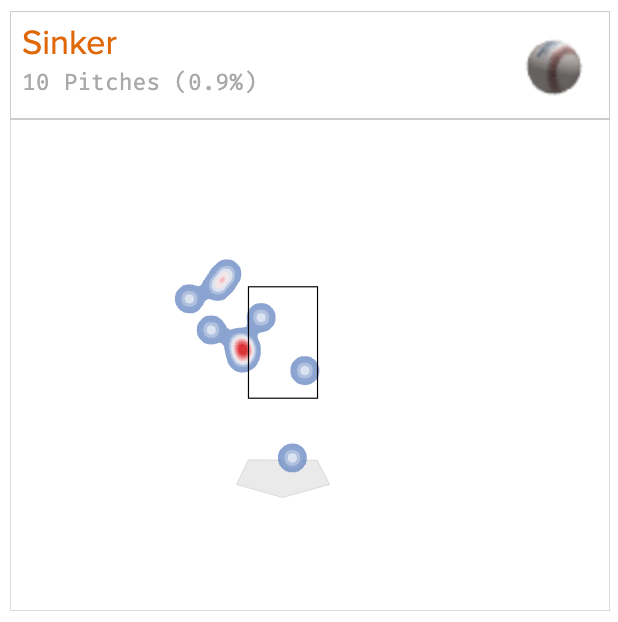
The sinker had above average horizontal movement and velocity, although the velocity could be due to the pitch being thrown only when he was in a bullpen role. This will be a pitch to monitor going into 2024 as Varland possibly competes for a rotation spot, making a fifth pitch all the more important.
2024 Outlook
The 2024 Minnesota Twins will be looking to compete with a roster that boasts a healthy mix of young talent and veteran stars. On the pitching side of things, Pablo Lopez and Joe Ryan are expected to anchor a starting rotation that will look to build upon the success they had in 2023. The Twins lose three solid players that made starts last season in Sonny Gray, Kenta Maeda, and Tyler Mahle. If they want to make the playoffs they will need young pitchers like Varland to take the next step and become solid starting pitchers to fill out the rotation.
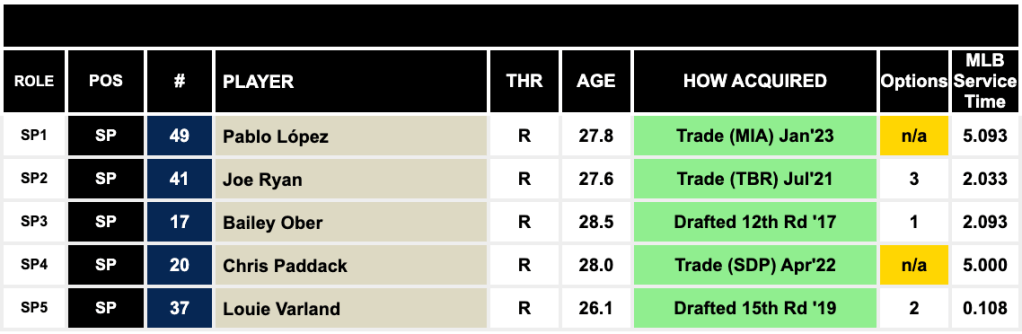
Fangraphs Roster Resource currently lists Varland as the fifth starter in Minnesota, and I see Simeon Woods Richardson as the only prospect with a chance to push Louie for innings next year. Unless the Twins make another move for a pitcher, Varland should get a longer leash to anchor the back end of the rotation. His pitch shapes and velocity’s will be something to pay attention to early in the season and in spring training due to how frequently they changed in 2023. He doesn’t have to pump 100 occasionally like he did in September, but getting the fastball to stick around the April velocity will be key to the pitches effectiveness.
| 2024 – Steamer Projection | GS | IP | ERA | K% | BB% |
| Louie Varland | 18 | 136 | 4.12 | 22.4 | 6.9 |
From a fantasy perspective, Steamer doesn’t project Varland to be incredibly valuable. One thing I think that’s important to look at here is his IP projection. Varland threw 149.2 IP in 2023 between MLB and AAA, so 136 IP would be a step down in innings, with him seemingly ready for a workload closer to 165-175 IP if he can stay healthy. Steamer also projects a drop in strikeout rate and rise in walk rate, which could come after he stops throwing out of the pen, but I’m a bit more optimistic. Projection systems aren’t perfect, and there’s no real way to account for a pitcher making dramatic changes such as the shape tweaks Varland made, as well as adding a pitch like the sinker. If the fifth pitch sticks and he’s able to optimize his arsenal and take advantage of the shapes that work for him, I could see him taking a huge step forward in 2024. The Twins will need someone to step up if they’re going to make the playoffs again, so there will be plenty of opportunity to compete.
Coleman Smith is a writer for and co-founder of LowThreeQuarter. See more of his work and others’ work on the site through the links at the top of the page, or explore another recent article linked below.




 Low Three Quarter Media
Leave a comment