

By Coleman Smith

2023 Stats: 254 PA, 14 HR, 41 RBI .249/.370/.507 .877 OPS, 18.8% Brl%, 31.5% K%, 11% BB%
2024 Steamer Projections: 440 PA, 16 HR, 53 RBI, .235/.334/.426 .760 OPS, 32.9% K%, 11% BB%
Matt Wallner has been a popular name on Fantasy Baseball Twitter this week, with many citing him as a possible breakout candidate in 2024 due to his hard hit numbers and great plate discipline. Much of the hype started with a tweet from @Roto_Frank about a Wallner grand slam and the sound off the bat. I’ve posted the video below for reference, and I recommend viewing with the sound on.
This baseball was unloaded on, and showcases the extreme raw power Wallner possesses. The numbers back this up as well, as Wallner finished with the fourth highest 90th percentile exit velocity in baseball. 90th percentile exit velocity correlates with home run rate stronger than any advanced metric other than barrel rate, and the hitters ahead of Wallner include Aaron Judge, Giancarlo Stanton, and Ronald Acuña Jr. This is elite company, and places Wallner among the greatest power hitters in the game.
Wallner also excels at plate discipline, with an above average chase rate and >10% walk rate. A popular new way to measure plate discipline is through what is called “swing decisions”. Basically, a hitter is rewarded for being aggressive in the strike zone and patient out of it, and penalized for taking strikes and swinging at balls. The graph below is from Thomas Nestico using his swing decision model, and I will also link his explanation of swing decisions. Using this metric, Wallner appears to have great in-zone awareness and above average out-of-zone awareness.

Where Wallner struggles greatly is making contact. While he is great at deciding to swing at pitches in the zone, Wallner’s contact rate on those pitches was the seventh worst among hitters with 100 plate appearances in 2023. There are two main swing and miss hitter profiles and I’m going to use two extreme examples to illustrate them: Joey Gallo and Javier Baez. Baez may have been one of the first names that popped in your head when you think “swing and miss profile”, with entire highlight reels being created of him swinging at pitches WAY out of the zone. Baez carries an extremely high swing rate in general, meaning he’s just up there looking for something he can get his bat on and isn’t worried about how good of a pitch it is. Gallo is the opposite hitter, known for being extremely patient with good plate discipline, but also a longer swing that generates power but often whiffs. Wallner falls into the Gallo category of hitter, with extremely similar barrel rates and Z-Contact%’s.
Matt Wallner vs Joey Gallo:
| K% | BB% | Z-Swing% | Z-Cont% | Chase% | Brl% | FB% | PFB% | |
| Joey Gallo | 42.9% | 14.2% | 71.6% | 65.7% | 25.9% | 19.3% | 41.4% | 49.4% |
| Matt Wallner | 32.6% | 10.7% | 69.2% | 68.6% | 27.1% | 18.8% | 33.8% | 23.8% |
We haven’t discussed some of the stats listed above, but I’m going to try to work them into my comparison of these hitters as best I can. Firstly, Z-Contact% measures how often a hitter makes contact with a pitch in the strike zone when swung at. Essentially, this measures a hitters ability to get the bat on the pitches they are most capable of doing damage with. Gallo ranked 2nd worst in the league in 2023 among hitters with 100 plate appearances, with Wallner ranking 7th worst. Both hitters struggled mightily getting the bat to balls in the zone, but when they did they both made it count. Both ranked among the top 10 in barrel rate in 2023, with Gallo in 6th and Wallner again in 7th. Where Gallo stands out however is his ability to put the ball in the air, and to the pull side.
Wallner puts the ball in play more than Gallo, with a lower K% and BB%. Gallo however makes the most of his balls in play, with a much higher flyball rate (FB%) and pulled flyball rate (PFB%). Gallo has long posted low batting average/high OBP/high SLG seasons, but in his early years he was able to support a high enough batting average to make him an above average hitter.
xwOBAcon measures how good a hitter is only on their balls put in play using exit velocity and launch angle, leaving out swings and misses and takes. In his most successful seasons from 2017-2019, Joey Gallo carried an xwOBAcon above .550 every year, which was top 1% of the league each season. Matt Wallner last season had a .499 xwOBAcon, likely due to his lower fly ball rate. Interestingly, xwOBAcon does not use spray angle in its calculation, meaning it also doesn’t account for Gallo’s higher pull rate (which would lead to a higher power output).

I’m more skeptical than many about Wallner due to this issue with putting the ball in the air, especially to the pull side. While his exit velocities place him among the games most elite hitters, I fear his swing profile will prevent him from getting the most out of these hard hit balls. Looking at his spray charts, we see most of his damage done to the pull side, but there also seems to be a cluster of about 8 balls in deep left/center field that were turned into outs that could’ve had a different outcome if pulled.
Wallner has tons of success elevating to the pull side, but hits a few too many of his balls middle/opposite field that end up turning into long outs. This is a problem for a hitter with a high strikeout rate and low contact numbers. If you struggle putting the bat on the ball and don’t swing very often, you limit your opportunities to make good contact, meaning when you do it’s important for it to be hit with ideal spray angle and launch angle.


Gallo was only able to sustain this profile as an above average hitter when his batted ball profile was in the top 1%, something very hard to do if you possess any holes in your swing. The strikeouts will naturally suppress the batting average, and Wallner doesn’t walk as often as Gallo to help out his OBP. He will need to hit for power consistently to be a regular big leaguer, and as a left handed hitter he’s at risk of platooning as well.
Wallner’s splits in 2023 were pretty ugly, with him excelling against right handed pitching but struggling against lefties. I’m going to post the slash lines below, and the difference is nothing to write off.
| AVG | OBP | SLG | OPS | K% | B% | Cont% | Brl% | |
| vs RHP | .281 | .409 | .561 | .970 | 31.4 | 11.6 | 64.5 | 20.8 |
| vs LHP | .119 | .196 | .286 | .481 | 32.6 | 6.5 | 59.5 | 11.1 |
Against right handed pitchers Wallner strikes out less, walks more, makes more contact, and makes better contact. This would typically be very worrying for a left handed hitter as they are already at higher risk for platooning, but taking a look at the Twins roster I’m not sure a platoon is viable. Twins who can currently play corner outfield include Wallner, Max Kepler, Willi Castro, Trevor Larnach, and possibly Emmanuel Rodriguez at some point. All of those players with the exception of Castro bat left handed, and Castro is a switch hitter who also struggles with left handed pitching. Barring a trade or free agent acquisition, I’m not seeing anyone the Twins could use to platoon with Wallner against righties. Despite struggles last season, Waller may be seeing at bats against lefties out of necessity.
When a hitters approach is as boom or bust as Wallner’s, its important not to have a zone on the plate pitchers know they can go to get you out. I keep mentioning Gallo because their approaches mirror each other a lot and they both spent time on the Twins together in 2023. One thing that likely led to Gallo’s downfall as a hitter was the discovery that he struggled to reach high pitches, especially fastballs.

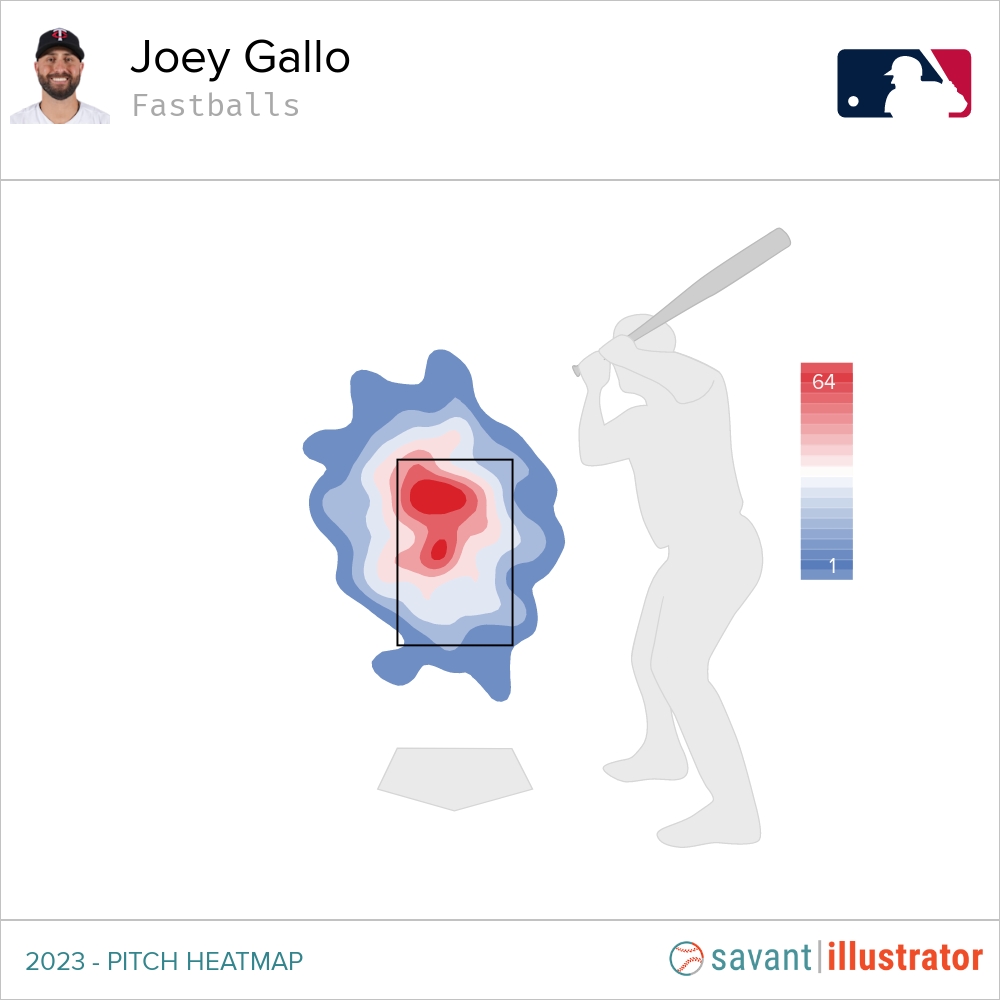
We can see from the swing and miss plot on the left that the distribution of fastballs is extremely tight in the up and away portion of the plate. What we also see is the total fastball plot on the right is also concentrated in the upper portion of the plate, with some misses closer to the middle of the zone. MLB teams have access to a plethora of data, more than is available to the public, and relay this information to pitchers and catchers. If a hitter has a specific zone they are known to struggle with, pitchers will pound that spot and force the hitter to beat them. This is especially true for hitters like Gallo or Wallner who aren’t going to chase. Pitchers know they must beat them in the zone, but if they make a mistake it’s going over the fence, so they attack the spots they know the hitter can’t make them pay.
Wallner, like Gallo, struggles to make contact consistently on fastballs up in the zone.

Wallner has a much wider swing and miss zone than even Gallo, meaning pitchers don’t have to worry as much about Wallner parking their high fastball 400 feet into the seats. Interestingly, Wallner does hit better against fastballs than Gallo, meaning when he gets a mistake he is able to make the pitcher pay. He has to find a way to make more consistent contact on fastballs up however, as he swung and missed at nearly a 32% clip againt them.
Wallner also struggles with pitches on the inner third of the plate. The charts below show batter run value, a metric that weights events based on things like count and runners on, as well as xwOBA and xwOBAcon. Wallner actually swings and misses at inside pitches less than other zones, but it’s the only part of the plate where his average exit velocity is under 90 mph. So while he struggles getting the bat to high fastballs, he struggles getting the barrel around to pitches inside.


I was interested in what could be causing Wallner to struggle to get around on balls inside, so I decided to take a look at his stance in the box.

Initially, Wallner stands very tall and upright, with his front leg in an open stance that allows him to see the pitcher well. If we were to draw a line from his front foot to his back foot, it would lead somewhere towards first base. This is a pretty typical pre-pitch setup, especially for a hitter who is 6’4 220 pounds. But where things begin to get interesting is when the pitch is on its way. The image below is of Wallner as he finishes his load and begins his swing as the pitch is approaching the plate. There are some notable differences.
First, the upright angle he stood at initially has dropped, with his head now out over his toes and his back creating closer to a 45 degree angle than 90. His feet have also switched orientation, now pointing out towards third base rather than first. This isn’t a problem in and of itself, many hitters including Giancarlo Stanton use a closed stance, but when he gets the foot down makes it an issue. The image to the right was taken the moment Wallner gets his front foot down, and the pitch is already halfway to the plate. By the time Wallner recognizes the pitch is heading inside, he’s already leaning in and completely closed off, not leaving himself enough time to get back open and around on the pitch.

I believe this could be part of what’s causing his soft contact on inside pitching. When he can get his barrel around to the ball, he hits the ball as hard as anyone in the league. We know from earlier Wallner doesn’t pull the ball in the air quite as much as we’d like from a guy who hits the ball this hard, and part of this could be due to struggling with the pitches typically hit to the pull side of the field.
Wallner’s stellar plate discipline and raw power make his ceiling as a player pretty exciting. The sound the bat makes when he really connects on a pitch is something few in the game are capable of producing. But the swing and miss must be addressed. The Twins appear to be pushing this style of hitting, finishing 1st in MLB in strikeout rate, 4th in walk rate, t-3rd in home run rate, and 5th in fly ball rate. We compared him to a hitter with a very similar profile in Joey Gallo who after a promising start to his career, wasn’t able to put it all together to become an effective big league hitter. The key to hitting for a good enough average for Wallner will be making more contact on pitches in the strike zone, which i’m not sure the Twins will try to fix. Their organizational hitting philosophy is to try to hit barrels without worrying about whiffs. If he continues to strikeout over 30% of the time, I worry he will struggle to be a consistent hitter.
| PA | HR | RBI | AVG | OBP | SLG | OPS | K% | BB% | |
| Steamer | 440 | 16 | 53 | .235 | .334 | .426 | .760 | 32.9 | 11.0 |
| ATC | 460 | 18 | 59 | .235 | .340 | .438 | .778 | 32.8 | 11.3 |
Both Steamer and ATC project Wallner’s K% to stay well above 30%. Both are also projecting mediocre power output in ~450 plate appearances, with 16 homers for Steamer and 18 for ATC. After turning in 14 homers in just 254 plate appearances in 2023, these would be disappointing performances in closer to a full season.
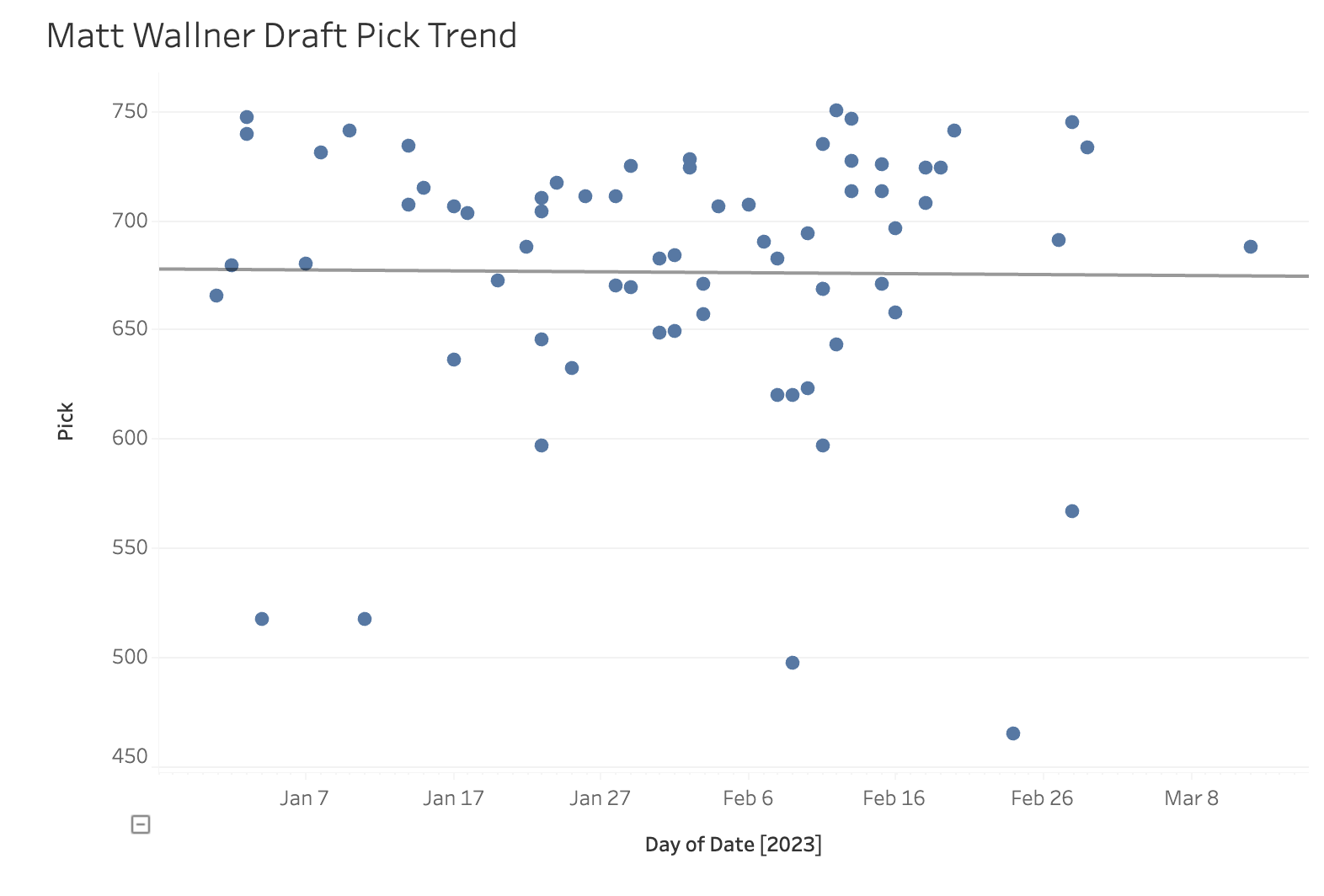
For fantasy Wallner is an interesting player. The cost should be very low, with his NFBC ADP currently over 600. In roto and categories leagues, he likely won’t provide much in average, but in OBP leagues the walk rate should raise his floor. This could be a very cheap dart throw power bat late in drafts with potential to boom if everything goes right. In points leagues, I worry the strikeout rate will make the floor far too low to justify holding Wallner on a roster year long. Using him as a streaming bat during the hot streaks and dropping during the weeks he strikes out 12 times may be the best option.
It will be interesting to see if the Twins can unlock more out of Wallner, or if he’s doomed to be a streaky power bat similar to Gallo. Making more contact in the zone and getting around on inside pitching will be key, and hopefully he can make the adjustments needed to become one of the most feared hitters in the game.
ADP chart from @JonPGH
All other images from Baseball Savant
Coleman Smith is a writer for and co-founder of Low Three Quarter Media. See more of his work and others’ work on the site through the links at the top of the page, or explore another recent article linked below.



 Low Three Quarter Media
Leave a comment