

By Josh Bookbinder
By The Numbers
This blog has often been focused on the quantification side of baseball, where we take the many numbers the game provides us with and try to crunch them, twist them, and warp them into understanding and predicting. We marvel at anomalies, triumph in our arrogance when we correctly predict something, and fume over inconsistencies that don’t make sense to us. It’s fun, somehow.
However, every year around the time the leaves start to change, we’re reminded of the fact that baseball is a silly game played by human beings, not numbers. Human beings who, in fact, do things that don’t make sense very often. Human beings who can sleep wrong and be sore, or eat a good breakfast and feel energized, or hit traffic in the morning and be irritable, or a billion other possible things that make the numbers from the prior 162 games near-irrelevant.
MLB’s playoffs aren’t designed in a way that regularly makes what we expect to happen actually happen. In fact, according to statistical research, it would be near-impossible for the league to do so anyway.
How long would postseason series need to be in NFL, MLB and NHL to match the NBA’s “better team advances” rate of 80%? …
- In the NFL, a “best-of-11” series is needed to match the NBA’s better team advances rate.
- In the NHL, a “best-of-51” series is needed to match the NBA’s better team advances rate.
- And in MLB, an astounding “best-of-75” series is needed to match the NBA’s better team advances rate.
Sources: Michael Lopez, see also: Lopez et al.
It’s why so many teams are becoming so rooted in their strategy of “just make it there, then anything can happen”. The regular season, while not exactly becoming an afterthought, is simply a way to get the ticket inside. Dollar signs and eyes are attached to the playoffs, not a cloudy 1:35 start time on a Tuesday in May. And as long as you have a ticket into the dance, you’ve got a shot at going home with the belle of the ball.
In October, it isn’t fair to say numbers go out the window. At a micro level, teams can still put themselves in a better position to win an individual game based on the decisions and matchups they make within said game. But all of those things that are tuned out as noise throughout 162 become incredibly important.
About Last Night
This brings us to, as I write, last night. Allow me to paint a picture for you, even if you know the story’s ending.
The Mets are on the brink of elimination, in the 9th inning of the decisive game in the Wild Card Series. The Brewers have their closer in the ball game with a 2-run lead, and this isn’t just any closer. Devin Williams is one of the absolute best, and comes into the game already hot. Since coming back from injury, his numbers in a stunted season are unreal. In 21 innings, he’s allowed 21 baserunners and struck out 38. He allowed a single home run this season in his second game back; he hasn’t allowed one for close to two months.
Francisco Lindor has been the Mets’ savior this series, and Williams does right to be careful with him. However, he’s too careful. Ball four.
With Lindor on first, Mark Vientos strikes out swinging on a 96 mph fastball. Back on track. Then, Brandon Nimmo does something incredibly impressive: he smokes Williams’ changeup through the right side for a single.
What’s so impressive about that? It comes down to Williams’ changeup being no ordinary changeup. He throws it with an incredibly high spin rate, creating exceptional break more akin to a screwball. And it’s been nearly unhittable; in his entire career, he’s thrown 2,299 changeups. He’s allowed only 75 hits, and only 6 have left the ballpark thanks to its wicked downward break. 3.2% of his changeups result in hits, and 0.02% turn into homers. Nice swing, Nimmo.
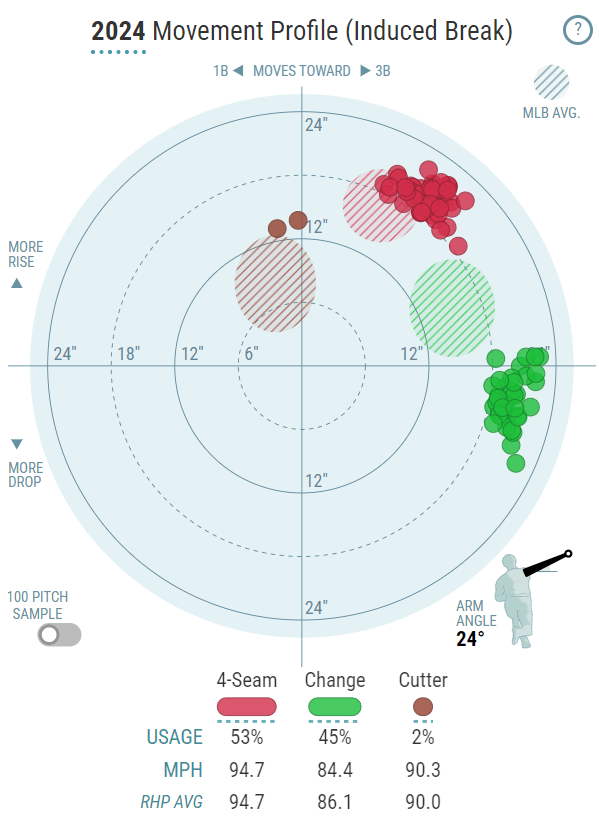
Williams’ pitch movement plot, 2024. BaseballSavant
So, here we are. Runners stand on first and third, lead runner steps into the box. It’s Pete Alonso.
Pete’s been an enigma this year. He’s right around his career-worst numbers in a walk year, and has drawn the ire of Mets fans all year. He’s talked a little publicly about his contract situation, and his comments did not sit well with his fanbase, especially in a year where he’s appeared to let them down. He’s struggled in this series already, going one for eight.
Pete works the count to 3-1; a fastball count. Williams goes to his bread and butter, spotting an 86 mph Airbender changeup on the outer third of the plate, likely looking for a ground ball to turn two; his changeup, when put in play, has resulted in a ground ball 66% of the time. By all the numbers, this should work out perfectly for Willams.
Jubilation in Queens. A postseason legend is born.
Unwritten
It’s fair to say that the playoffs are the last bastion of the old school crowd, the “baseball is magic” crowd, the storyline crowd. There are things you just can’t predict, can’t math out, and can’t explain that happen when October comes along. Sometimes Smith, Minter, and Matzek just become unhittable. Sometimes Howie Kendrick finds a foul pole. Sometimes Bryant’s foot slips, but the throw stays true. Sometimes Madison Bumgarner becomes superhuman.
The leaves are changing again, and in many places, a chill breeze swirls under the brims of ballcaps and through the buttons of a jersey. With it, the magic of baseball grows stronger.
There’s only more to be written.
Josh Bookbinder is a writer for and co-founder of LowThreeQuarter. See more of his work and others’ work on the site through the links at the top of the page, or explore another recent article linked below.



 Low Three Quarter Media
Leave a comment