
Baseball’s Process Of Improvement
By Josh Bookbinder
After a long hiatus, LTQM is back online. And naturally, it’s to discuss one of the most pressing issues in the entire sport: why is a semi-obscure Yankees reliever bad?
Background
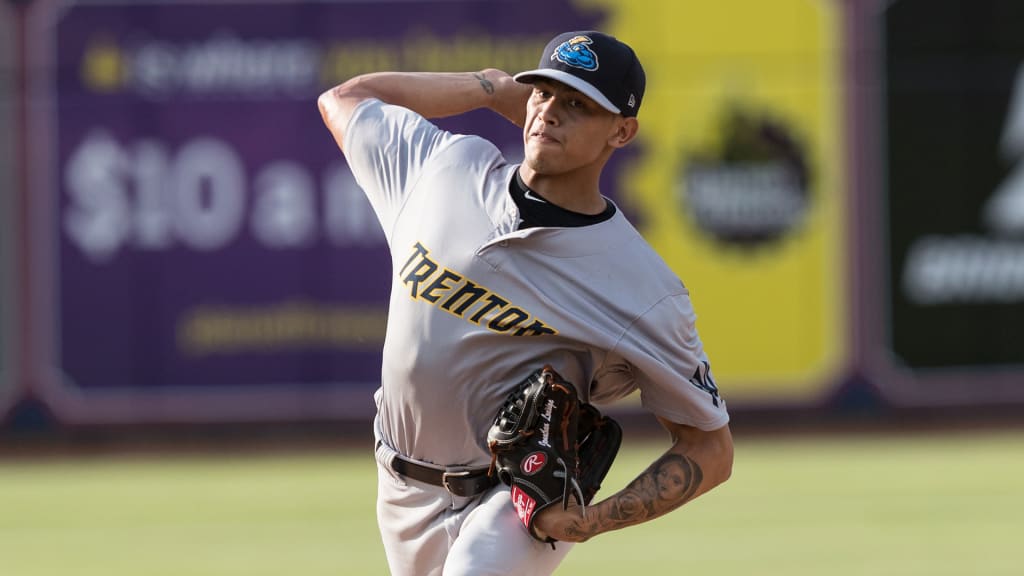
Jonathan Loáisiga was originally signed out of Nicaragua by the Giants in 2012, and had a rocky 6 years in the minor leagues. He was released, missed much of those 6 years with injuries, and struggled to find himself as a pitcher. However, it all began to come together by 2017, leading to him being named a Yankees top-30 prospect heading into 2018.
When Loáisiga arrived in the big leagues in 2018, he flashed electric stuff but struggled a bit in his first three years, putting together a 4.42 ERA (99 ERA+), 26% K%, 10% BB%, and 47% ground ball rate over 36 appearances (11 starts, 79 IP). He was an average arm without a truly defined role, and despite a flaming fastball with ridiculous movement, he didn’t produce elite results.
Then, 2021 rolled around. During in injury-plagued 2021-2023, Loáisiga broke out as a valuable bullpen arm as soon as he was given a defined role, putting together a 2.97 ERA (141 ERA+) and lowering his walk rate to 6% over 124 appearances and 136 IP. The biggest difference outside of the improved command was a consistently excellent 59% ground ball rate, much improved from the 47% from his first three years.

After his 2024 season was lost to elbow surgery, he’s come back in 2025 looking like a different pitcher, and not in a good way. His ERA through 29 IP sits at 4.25, but the feelings behind the outings as well as the peripherals have been much worse. He’s allowed 7 home runs and his ground ball rate has dropped back to the 50% mark. His WHIP is sitting at 1.48, his worst mark since 2019. Worst of all for the old-school baseball people (and the Yankee fans), his outings have looked and felt scary; huge misses, middle-middle meatballs, and the feeling like at any moment, the game could explode on him. His outings had largely been confined to mop-up situations prior to an injury that kept him out almost the entirety of August. Something changed; what was it?

First, let’s identify what the issue is. The stuff is still electric, but the command has been poor. It’s important to know the difference between control and command here; control is the ability to throw strikes, which Loáisiga has always been fine at. He averages around 50% InZone%, about average in today’s game. Command is the ability to throw the ball where you want in and out of the zone, which is difficult to track or have quantitative metrics to back up. Loáisiga is missing more and bigger this year; again, this I have no stats to back up, but the eye test. Command is usually most closely connected to the delivery itself. He’s also struggling with his groundball rate, which usually is related to movement, arm angle, and delivery. So the plan should be to check the metrics that relate to command and ground ball rate first, then try to find a reason for any changes we see.
Why Do This?
I think trying to fix this random reliever is an interesting exercise because it can really show the process that a coach, a scout, an analytics department, or a player takes when trying to improve based off of results. As someone who has held a couple of those mentioned roles, I think it’s a significantly misunderstood process.
Lots of fans without the high-level experience struggle to understand what is so difficult about getting better; there is a misconception that it’s simply “not working hard enough” or something similar. And that’s a fair thought to have! In many disciplines, that’s true. But in a sport as fine-tuned as baseball, small things can make massive differences, and without using the information at your disposal correctly, you can be largely ineffective in your efforts or worse, harm your performance even worse than before. A quick story from my own playing days comes to my mind to show just how difficult this process can be.
At one time, I was recovering from Tommy John surgery myself, and I was determined to improve. One thing I had always struggled with was weight; I was always underweight for my size, and despite a fastball that topped out around 93 mph, it was the opinion of most of my coaches or trainers that I needed to put weight on to get back to where I was or higher in velocity. So I did what any hardworking athlete did, and worked my tail off; I went from about 195 pounds to 215 by the time I was back throwing off of a mound. What I found was that with the new weight, my body didn’t move as efficiently, and I was only throwing about 85 mph. I shed the weight, and immediately got back up to around 88-90.
These changes that players make can be in the best interest of everyone and follow all traditional wisdom, like mine did, and still not work. It’s important to take all factors and information into account to be sure you’re performing at the best of your ability, and the importance of that is magnified on the biggest stage.
The Process
The first thing to look at with Loáisiga is velocity, as it often is with pitchers. However, that’s largely unchanged from his career-best years. He’s still throwing around 97mph on his fastball, which is less than half a mph under his best years; a little bit of a drop, but not enough to make a huge difference, especially for a guy who relies on getting ground balls, not strikeouts.

His movement is largely unchanged as well, which is interesting, considering that’s one thing we would expect to be different due to the ground ball rate. The horizontal and vertical break are right in line with career averages, other than his curveball, which doesn’t feature as a large part of his arsenal.


The next point to identify then is release. This can significantly change results, as a hitter subconsciously makes calculations on where and how the ball will move and be located based on how a pitcher delivers. Let’s see if horizontal or vertical release changed.
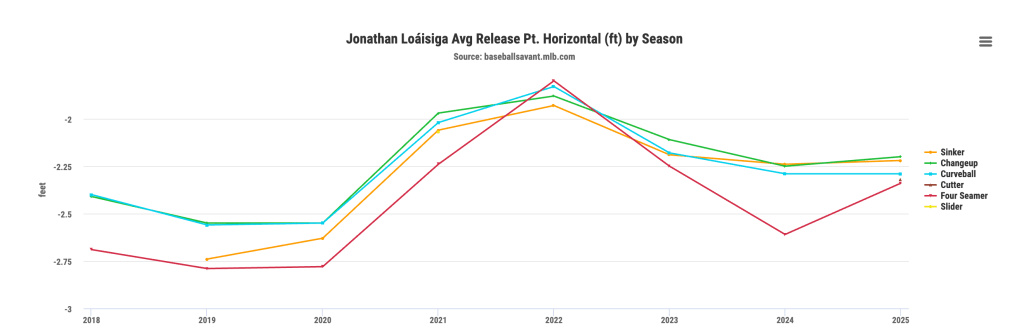

Whoa. Now we’ve got something.
Loáisiga’s arm angle has changed massively since he came into the league. His vertical, how high he releases, has dropped lower and lower, while his horizontal, how side-to-side he released, spiked closer to his body in his best years and went back further out in his worst.
So pretty clearly, the issue is in his delivery. His deception has been greatly reduced by the fact that his arm is not moving the same way it did in his best years. Perhaps this has also affected his command. So what does that look like in real life, outside of charts, and how do we fix it?
Video has become a massive tool for players in the last decade or two. It’s always been around; Tony Gwynn talked about using it obsessively to hone his legendary swing in the 80’s. But now that ludicrously high-quality video is available in most people’s pockets, and even more ludicrously high-quality video is available to all MLB organizations, it has become a tool that every player relies heavily on. Let’s take a look at a comparison between Loáisiga’s delivery from 2021 to 2025.
Here’s a fastball for a strike in 2021:
And here’s 2025:
Both sinkers for strikes against right-handed batters at home. Let’s see what kind of differences we can point out at certain checkpoints in the delivery.
First, starting point. There are some clear differences right away.
Here’s 2021:
Here’s 2025:
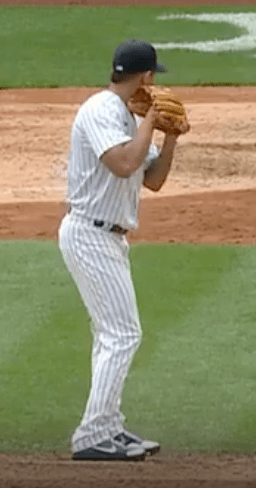
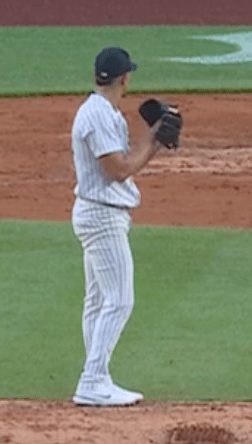
Even with differences in camera angle, we can see a huge difference in glove position and head position. There also seems to be a lateral weight shift, with more weight put onto the heels. 2025 seems more relaxed, but less athletic. Loáisiga has always been a very athletic pitcher, and losing some of that may be detrimental to him. However, starting position usually is just something that influences things later in the chain, not something that causes issues on its own.
Next, let’s look at peak leg lift, the moment when his leg gets as high as it can be.
Here’s 2021:
Here’s 2025:


Big differences. The 2025 still image shows hands higher and tighter to the body, head tilted more upwards and backwards, knee angle wider, toes tilted higher. Again, everything seems looser in his movements, a good cue for some pitchers, but not everyone.
Let’s check in at handbreak, when the throwing hand leaves the glove.
Here’s 2021:
Here’s 2025:
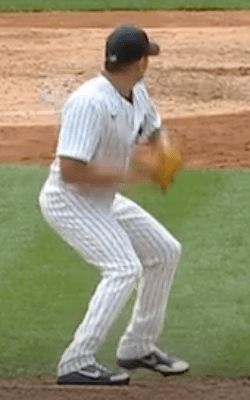

In 2025, the legs are split wider, the hands break further from the body and lower, and theres a significant difference in where the weight is placed. Despite the head being leaned further back, it almost looks like the weight is poorer stacked on the second-base side, likely leading to less balance. This could be a clue into why the command has been worse.
Our next check in is at front foot strike, or when the front foot hits the ground and weight is transferred to it.
Here’s 2021:
Here’s 2025:
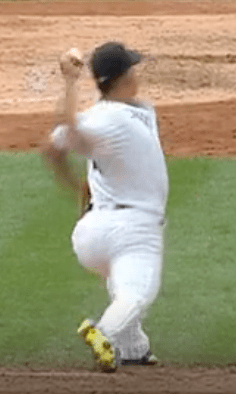

Again, it just looks like everything in 2025 is wider and wilder. The lower half looks similar, but the arm is laid back earlier, the trunk is less in line with the arm, and the front side is far more open towards the first base side. There are clear indicators that would indicate command might suffer.
Finally, let’s look at release.
Here’s 2021:
Here’s 2025:
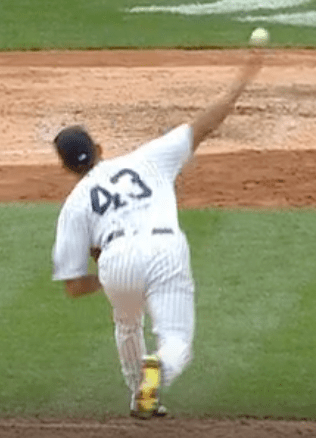

The arm angle in 2025 is definitely lower and further from the body. I feel like a broken record, but it’s also clear that everything is just less connected and “looser”; you can see it in the glove arm being lower and further from the body and the legs being spread wider apart.
If you look at the video, you can also see a clear difference in deceleration, or how he finishes his delivery. This is difficult to convey in still images, but the 2021 video shows a finish more direct towards the plate, while the 2025 video shows more of a fall off towards the right. The finish of a pitch after the ball is out of the hand doesn’t matter much, but like the starting position, can be an important feedback indicator.
There are many more layers to what we can find, but we don’t have the time nor the information access that a professional organization does. However, I’m confident the Yankees have begun to address this already; recently, Loáisiga went on a rehab assignment to get ready to come back from an injury. A video from that outing shows great progress toward his 2021 form:
While some of the positions within the delivery are more similar to 2025, the starting position, deceleration, and finish are more similar to 2021 than 2025. This is a good sign to me, and an indicator that he’s moving in the right direction.
This is what I would do as a player or coach. I’d review the data, identify key negative differences, and take to video to try to replicate what it was that worked. It seems like Loáisiga has followed a similar path, and hopefully that leads to good results moving forward.
The bad news, however, is that Loáisiga was recently shut down from that rehab assignment with yet another injury. And as a pending free agent this offseason, it may mean the end of his Yankee tenure, or even the end of his tenure as a pitcher with a guaranteed significant role in a bullpen. Hopefully, he’s able to follow this process himself in order to find his way back to the form that made him an exciting and effective reliever.
Completed Exercise
Hopefully, this process shed a little bit of light into what it actually means to use analytics, data, and video to make in-season adjustments and mechanical tweaks. There’s no telling what the future holds for Loáisiga specifically, and as a Yankee fan, I hope he’s able to get back right and healthy to help the stretch run for the team. However, as a baseball fan, I more so hope that we’re able to see the version of Loáisiga that seemed to be destined for the 9th inning in big moments.

Josh Bookbinder is a writer for and co-founder of LowThreeQuarter. See more of his work and others’ work on the site through the links at the top of the page, or explore another recent article linked below.
 Low Three Quarter Media
Leave a comment