

By Josh Bookbinder
Shintaro Fujinami is two different baseball players. The first player is an absolutely electric arm with eye-popping velocity, a smooth but violent delivery on the mound, and 10 years of a quality NPB track record. The other is a pitcher with one of the worst ERAs in the majors in 2023 and was relegated to a mop-up bullpen role. I wanted to dive into the numbers to try to understand why exactly “Fuji” has existed as such an enigma in his first year stateside.
First, if this article is a curiosity to you, and you haven’t been introduced to the Fujinami show yet, allow me to give you a place to start:
It looks unhittable, and for a long time in a place far away from Baltimore, it was. Here’s what Fuji’s NPB stats looked like from 2013-2022:
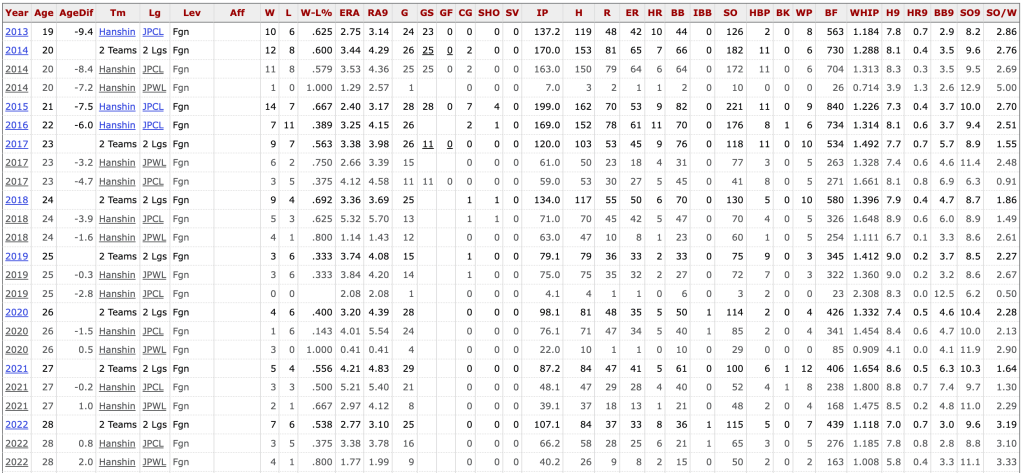
A 3.41 ERA in almost 1,000 innings in a legit league like the NPB can’t be ignored. Fujinami is electric to watch undoubtedly, and has the capability to be really good.
However, this line in particular is… concerning.

Fujinami pitched to one of the worst ERAs in the majors in 2023. He allowed 63 earned runs in 79 innings, including 47 earned in 49.1 innings before being traded from Oakland to Baltimore. Despite unhittable stuff, he was one of the most hittable pitchers in baseball. How?
Let’s start with his fastball. Despite 97th percentile average velocity and a top velocity as high as 103mph, the pitch graded out as being worth -7 RV, good (?) for 553rd out of 600 value-wise. The velocity is outstanding, but it’s also inconsistent. Statcast officially records him as having a range of 5.1 mph on his fastball, tied for the largest gap in the majors, but it has been even larger than that. The difference between his average fastball velocity and his top velocity is over that on its own. While that can be an advantage in some situations for come pitchers, combined with poor location, it ends up hurting Fujinami.
Speaking of location, that’s another huge issue. Poor off-speed and breaking command can be overcome by good fastball command; however, Fuji’s fastball command is… I’ll let you take a look.

The misses are shockingly bad. Some of them are comically bad, like this one, or this one, or this one. But it’s more than just the big misses that are a concern; compare Fujinami’s chart to 2023 walk leader Blake Snell’s:
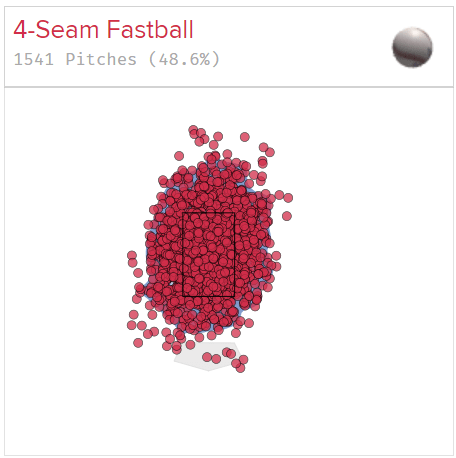
The misses from Snell are centralized, and many are “competitive”. It’s more of an old-school mentality, but “competitive misses” play a huge role in Fujinami’s struggles. When a pitcher isn’t able to put pressure on hitters by throwing pitches at least somewhat near the strike zone, it makes those pitches that are in the zone that much more hittable. There’s a reason why Snell led the league in walks and won a Cy Young, and Fujinami was one of the most hittable pitchers in baseball despite elite velocity.
Speaking of hittable, Fujinami’s fastball movement is decidedly average. It has 14 inches of drop, which is slightly more than should be expected for a fastball of his velocity, and 11 inches of run, which is just a little more than would be expected. While it spins efficiently, it spins at a very low rate, averaging just over 2000 rpm; that is 537th out of 554 qualified 4-seam fastballs. While an outlier number like that can be good, it requires command and understanding of its profile to be used to its full potential, and this is something that Fujinami clearly doesn’t have under control.
We’ve covered the fastball a lot, but what about the off-speed stuff? Well, to no one’s surprise, it wasn’t particularly good. However, let’s start with a positive, and check out the one pitch that had a positive run value: Fuji’s cutter, at +3.
It spins at 2041 rpm, which stacks up at for 218th out of 231 qualified cutters. However, this also means that it would be expected to have far more vertical drop than other cutters, which it does; however, it also moves far less horizontally than other cutters, thanks to a gyro/bullet spin profile. That pitch is apparently one that’s doing something right, and might not need a ton of adjusting.
Fuji also throws a splitter at almost 93mph, which is the second-fastest splitter in baseball; unfortunately, it moves exactly how hitters would expect it to, and because of this it got hammered to a -4 RV. Savant shows a sweeper that has a decidedly different profile than anything else, but again, it moves at a very average level, which also resulted in -2 RV in just 86 usages. Another interesting Savant note is that Fuji also apparently has a curveball, but he only threw it once, and a slider, which really just looks like a misread of the cutter.
Ultimately, what it looks like is that Fujinami struggles to spin the baseball, but still tries to throw spin-based pitches, which results in very average movement profiles. The splitter, the one pitch that he throws that doesn’t rely on high, efficient spin, doesn’t move enough or have enough separation from the fastball to be truly effective, and probably needs some adjusting; while it is incredibly fast for a splitter, the separation between the fastball and split is only about 4-6 mph, which is a very average number.
One of the most common themes throughout this breakdown of Fujinami are discussions of control and command. However, one of the most concerning things about his raw numbers is that they’re not that far off from his NPB career numbers:
| LEAGUE | HR/9 | BB/9 | K/9 | K/BB |
| MLB – 1 season | 1.0 | 5.1 | 9.5 | 1.84 |
| NPB – 10 seasons | 0.5 | 4.1 | 9.4 | 2.31 |
The strikeouts are virtually the same, and while he walked 1 more hitter per 9, it ultimately isn’t that huge of a difference for a pitcher who is going to rely much more on strikeouts and quality of contact control than a low WHIP. But with that quality of contact control in mind, he also let up twice as many home runs as his career norm. This is concerning coming over to a league with better offensive production: it begs the question, will he be able to adjust enough to succeed at the highest level against really good bats?
A picture of Shintaro Fujinami as a pitcher is someone who will light up the radar gun, but outside of that is almost the epitome of average. The stat sheets, arsenal, and Statcast movement profiles have been decidedly unimpressive so far. However, his lack of ability to spin the ball, in the hands of the right coaching, might be more of an advantage than a disadvantage, and I wouldn’t be surprised to see a large arsenal change in the next year or two. However, Fujinami is 29 years old, and has had a lot of success in the past; it remains to be seen whether he’ll be willing to make the changes he needs to be great in MLB.
Fujinami is an Oriole until 2029, and here’s hoping it’ll turn around for him sometime before then. Clearly, there’s an elite track record there, as the NPB numbers have shown; it just hasn’t clicked yet in the States. Hopefully, there’s somebody out there who can help him harness his talent to be at the very least a serviceable reliever in the coming couple of years. He’s going to be must-watch; hopefully, he’ll be really good, too.
Josh Bookbinder is a writer for and co-founder of LowThreeQuarter. See more of his work and others’ work on the site through the links at the top of the page, or explore another recent article linked below.




 Low Three Quarter Media
Leave a comment