

By Josh Bookbinder

Check this sweet Haniger x Mariners photoshop.
Mitch Haniger caught headlines recently as part of the trade that brought Robbie Ray to San Francisco, and while the trade was interesting, it certainly wasn’t what most people were hoping for when they saw a “BREAKING: …” tweet notification from Jeff Passan. With names like Blake Snell, Cody Bellinger, Jordon Montgomery, and a few others unsigned, this move would have made waves two years ago, but was more just a drop in the ocean in early 2024. A cash-neutral swap of injury-prone veterans all two years removed from career years certainly doesn’t get the needle moving like, say, last year’s NL Cy Young Award winner signing would.
However, when diving into the numbers, I found that there’s more beneath the surface for Mitch Haniger, and I wouldn’t be so quick to write him off — if he’s able to stay on the field.
Injury History – Concern or Bad Luck?
Towards the end of last season, AppleTV showed this graphic on their broadcast:

Mariners fans and Giants fans alike gave their sharp-tongued opinions of Haniger when this graphic was posted on Reddit:
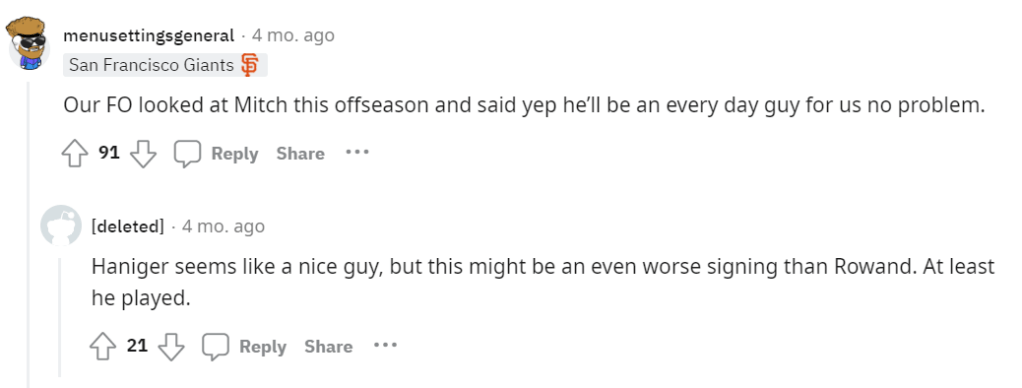


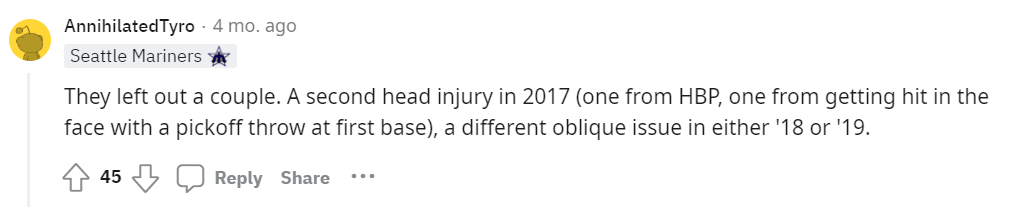
There’s also this one, which is especially funny now, in the wake of the trade:

However, the more I searched and searched through Haniger’s extensive injury history, the more I realized something, and the more it dawned on me that I couldn’t ignore. Then, I found one more comment, the most salient one on the entire Reddit thread.
It was a Rangers fan who expressed the sentiment I kept coming back to in my head but hadn’t really been able to put into words:

Haniger has been broken. A lot. He’s broken bones, he’s gotten brutal cuts, and he’s popped… well, you can read the graphic. However, most of these injuries are pure bad luck; getting hit by pitches, hit by throws, landing wrong, etc. Other than the oblique issues, they’re not really predictable injuries.

Now, I’m not saying he’s not injury-prone, and I think it’s more than likely he’s going to miss some time every season. But the biggest concern with Haniger has been health; he’s only played in 57% of possible games since 2017. When he’s been on the field, he’s been very good… other than 2023 (but se’ll get to that later).
Track Record: 2017-2022

Haniger’s rookie card with the DBacks.
Haniger joined the Mariners before 2017 in the deal that sent the Diamondbacks Taijuan Walker and Ketel Marte, and was immediately productive in a little over a half-season hampered by oblique, head, and face injuries (2 out of 3 bad luck injuries). He then broke out in 2018, posting a 139 OPS+ in a full season uninterrupted by scrapes or bruises. In 2019, he was again slowed by an injury, this one… we won’t talk about. He missed the entirety of 2020 thanks to core surgery, then bounced back to play a full 2021 in which he put up another career year, with a 122 OPS+ and 39 home runs. Finally, in what was a contract year in 2022, he had the bad luck of suffering a brutal ankle strain that cost him the majority of the season.
So, to review: from 2017-2022, six seasons, Haniger has played a full season in two. Those years, he had an OPS+ of 139 one of them and hit 39 homers in the other. Haniger established a track record of stellar offensive production, one way or another, and with the qualifier “when he played”, from 2017-2022. So what went wrong?
2023: The Disaster, With Hypothesized Reasoning
The Giants signed Haniger prior to 2023 thinking they’d get a solid producer when healthy, and they’d fill in the gaps when he wasn’t. Unfortunately, he wasn’t healthy, and the 60 games he spent on the field were the worst of his career: .209/.266/.365/.631, 73 OPS+.
It would be easy to blame this on the change of scenery to one of the worst power-hitting environments in baseball, but that wasn’t the case; Haniger’s numbers were actually slightly better at Oracle Park than on the road. So, then, what was it?

nightmare nightmare nightmare
My hypothesis is this: as Haniger has gotten older, most of his value has been in his power numbers. He doesn’t really hit for average, but he does put the ball over the fence and in the gap. I wonder if his power was sapped by both the change in scenery (his numbers, while slightly better at home, were still far below his career average) as well as the injuries he sustained in the 2023 season. I also think he got really unlucky, but more on that later.

In March of 2023, only five games into his truncated tenure as a Giant, Haniger strained his left oblique, a muscle now-notorious in baseball for its role in many season-altering injuries. He came back from this injury after only 21 games missed, half of what he required to recover in 2017, when he was six years younger and pulled his other oblique.
Upon his return, he was promptly terrible, hitting 10 extra base hits in 35 games before a particularly gruesome hit-by-pitch broke his right forearm. This would have been another power-sapping injury, and when he returned, he was even worse, generating only 7 extra base hits in 21 games.
Something interesting was going on under the hood here, as well, indicating some poor luck. Despite Haniger’s poor performance, many of his batted ball numbers were right in line with career averages. His average exit velocity was on the higher end of his career norms, and his HardHit% was also still good.

Perhaps the biggest vote of confidence lies in the expected numbers. His xBA and his xSLG were both exactly in line with his career averages. His xwOBA was 0.042 higher than his wOBA, indicating incredible unluckiness; 3rd least lucky in the majors, to be exact. Finally, his xwOBACON was also directly in line with the rest of his career numbers.
However, it wasn’t all good. His BB% was lower than career norms, along with his pull% and max exit velocity, and his K% was almost a career-high.
So what happened here? What is the verdict on Mitch Haniger’s 2023?
I wonder if a full off-season coupled with a return to a place that he knows well and has had success at in the past would give him the boost he needs to be a contributor again. I’m not suggesting that Haniger did anything crazy irresponsible by coming back while still injured either time, but a lot of noise about being injury-prone probably weighed on him. A lot of numbers show there was a lack of power in his swing, like the pull numbers and max exit velocity.

All of this combined with the pressure of the new contract with his hometown team (Haniger is from San Jose), it all might have made him push a little harder than he should’ve. Athletes are competitors, and competitors at the highest level in the case of MLB players. Undoubtedly, there’s pressure to succeed, and the low BB% and high K% compared to career averages might’ve shown some pressing from the player himself.
Also, many of the expected numbers can tell us that Haniger did get extremely unlucky throughout 2023 for the games he was on the field. Sure, he wasn’t hitting the ball as hard as usual and was likely both hampered by injury and/or pressing, but the numbers say that the 60-game sample size was marred by brutal luck as well. After all, 60 games is a finicky sample size prone to streaks above or below normal production; ask 2020 batting average champion DJ LeMahieu (.364) or home run champ Luke Voit (22).
Projection: Where Does This Leave Us?
Look, I’m not going to say that Haniger is a lock to return to his 39-homer or 139 OPS+ peaks. I’m also not going to say that he’s going to stay on the field for the Mariners. I don’t think either of those are realistic expectations for him.
However, I am saying that he’s someone to watch out for a little bit. In fantasy leagues, particularly deeper redrafts or keeper leagues, he’ll likely be very cheap to pick up as a speculative add. If a return home and some recovery time are all he needs, I wouldn’t be surprised to at least see him be a value add for a team that needs as much production as they can muster, and for fantasy owners who could use a good month or two before some sort of likely IL stint.
Seattle isn’t a particularly hitter-friendly ballpark, true, but Haniger might just be someone who can hit there if he’s on the field.
After all, he has before.

 Low Three Quarter Media
Leave a reply to The LTQ Crew: How our article subjects are faring early in the season – Low Three Quarter Media Cancel reply